



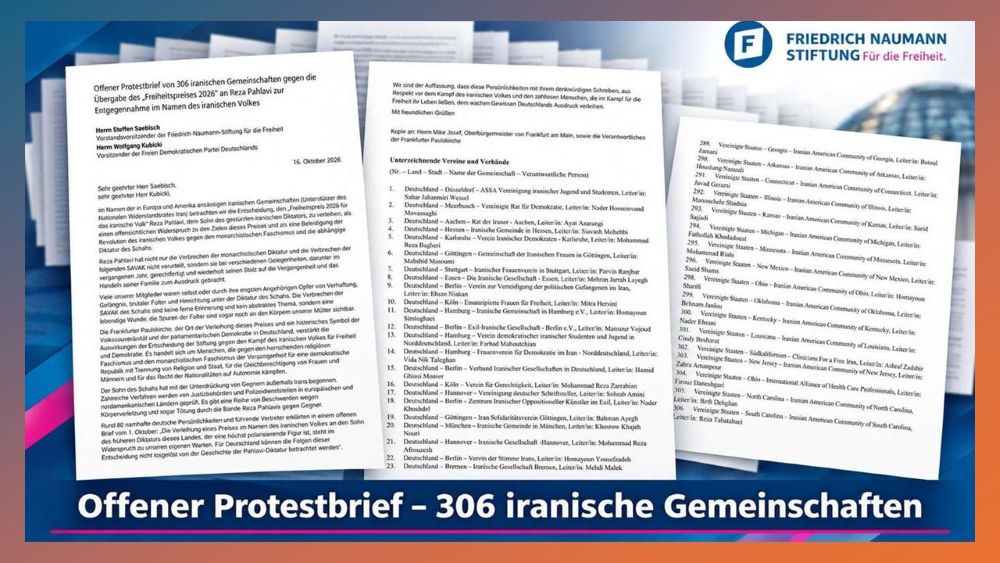
Prominent German figures, former political prisoners and republican organizations are demanding answers over the controversial award ceremony planned for Frankfurt’s Paulskirche.
In a letter dated October 16, 306 Iranian associations and communities, including 70 from Germany, as well as groups from across Europe, the United States, Canada and Australia, protested the Friedrich Naumann Foundation for Freedom’s decision to allow Reza Pahlavi to receive the “2026 Freedom Award for the Iranian People.” The signatories consider the decision contradictory to the award’s stated purpose and a disregard for those Iranians who reject both today’s religious dictatorship and a return to monarchy. The planned venue adds further controversy: Frankfurt’s Paulskirche, a historic symbol of parliamentary democracy and popular sovereignty.
306 Iranian associations from Europe, North America and Australia have addressed an open letter to @FNFreiheit & @fdp leaders, condemning their decision to award 2026 Freedom Award for the People of Iran to Reza Pahlavi, son of Iran’s former dictator. #No2Pahlavi 1/4 pic.twitter.com/H6UXbctQhq
— APA-ICE (@APA_ICE) October 16, 2026
The letter marks the latest development in a broad wave of protests. Previously, 82 prominent figures from Germany—including members of the Bundestag, former ministers and diplomats—had criticized the honoring of a “deeply polarizing figure” in the name of the Iranian people. The signatories included former federal ministers Herta Däubler-Gmelin and Brigitte Zypries, former federal minister Peter Altmaier, former chairwoman of the Council of the Evangelical Church in Germany Margot Käßmann, former Federal Constitutional Court judge Susanne Baer, and 15 members of the Bundestag. Former political prisoners from the Shah era and survivors of torture by the SAVAK intelligence service also spoke out. Six of them described imprisonment, abuse and executions under the Pahlavi dictatorship in a separate protest letter, warning against relativizing the memory of its victims through such an award. In addition, 25 Iranian organizations and political parties from a broad republican political spectrum have protested.
The criticism centers not only on the intended recipient’s biography but also on his handling of his family’s political legacy. Reza Pahlavi has yet to unequivocally condemn the monarchy’s repression and SAVAK’s crimes, critics argue. For former prisoners, torture, humiliation and the deaths of fellow inmates are not abstract historical issues but wounds that remain open to this day. Iranian dissidents also point to reports of threats, intimidation and assaults by monarchist supporters in several Western countries are in some cases being examined by police or judicial authorities.
Over 300 Iranian associations are protesting @FNFreiheit decision to honour Reza Pahlavi.
Our message is clear: Iran’s future must belong to its people, not to hereditary rule or religious dictatorship. We seek a democratic republic based on freedom, equality, and separation of… pic.twitter.com/wRjWnudzqo— APA-ICE (@APA_ICE) October 16, 2026
The Iranian communities say that, despite these objections, they have yet to receive a substantive response from the foundation. Many affected individuals regard this continued lack of acknowledgment as hurtful, and it has deepened mistrust. A transparent statement from the foundation is therefore urgently needed. It should not only disclose the criteria behind its decision but also explain why the objections of 306 associations, numerous civil society figures, former political prisoners and republican organizations have so far gone unanswered.
The full text of the open letter is available in the original German at the following link:
Read the full open letter in German