



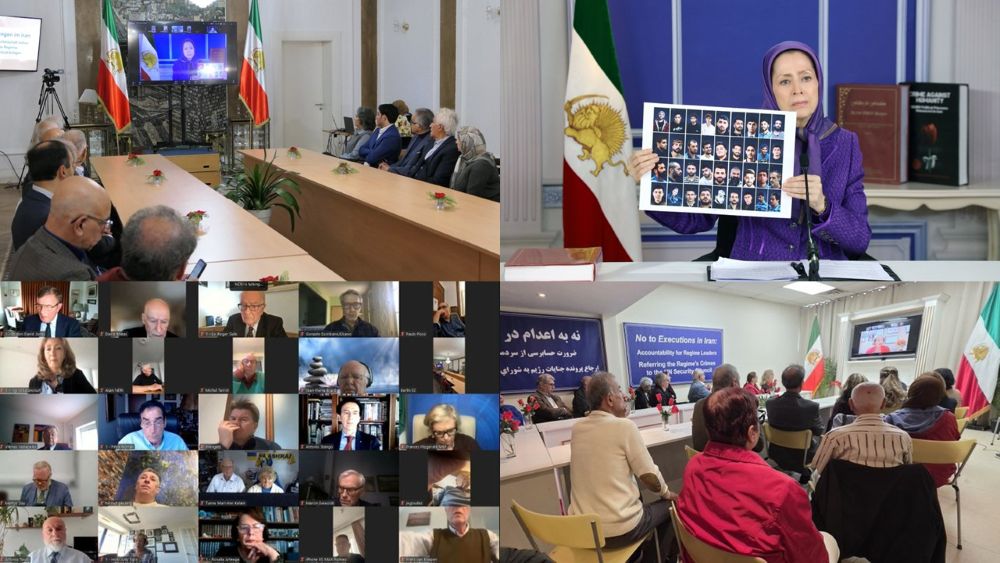
On the World Day Against the Death Penalty, Mrs. Maryam Rajavi, President-elect of the National Council of Resistance of Iran (NCRI), calls for urgent international action to halt executions in Iran and end decades of impunity for human rights violations and crimes against humanity.
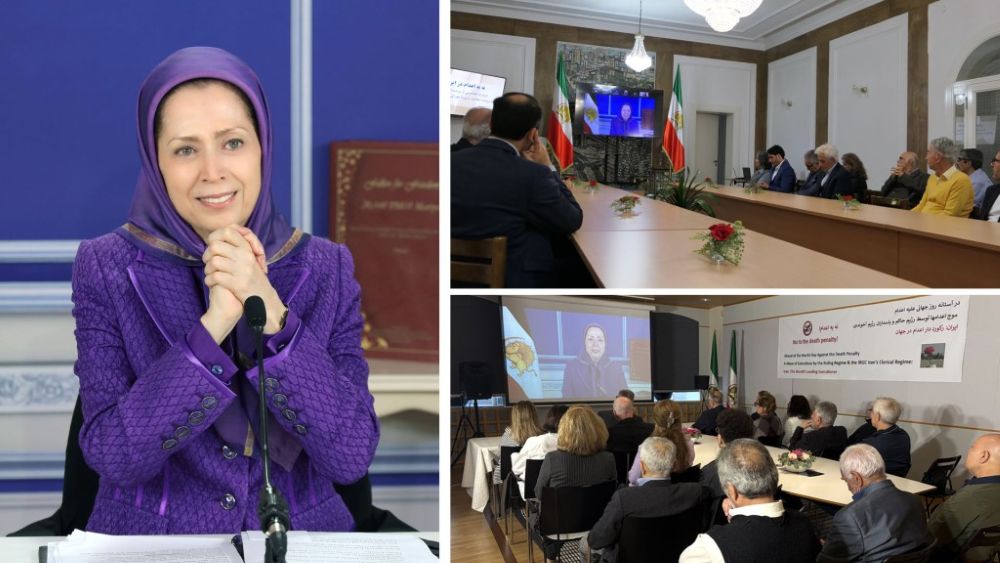
In her message to a conference marking this international day, Mrs. Rajavi pays tribute to the executed political prisoners, protesters, and all those who have sacrificed their lives in the struggle for freedom in Iran. She highlights the alarming scale of executions under the clerical regime, the growing threat facing political prisoners, and the determination of Iranian society to resist repression and reject the death penalty.
Mrs. Rajavi urges the United Nations Secretary-General and the international community to launch a coordinated international initiative to stop executions, protect political prisoners, hold those responsible for crimes against humanity accountable, and ensure that human rights are made a fundamental condition of relations with the Iranian regime.
Emphasizing the Iranian Resistance’s vision of a democratic republic founded on freedom, equality, the separation of religion and state, and the abolition of the death penalty, she calls on governments, human rights organizations, and all defenders of human dignity to support these urgent demands.
Message to conference on World Day Against the Death Penalty
October 10th is the #WorldDayAgainsttheDeathPenalty.On this day, we honor all the brave men and women in Iran who were executed for their struggle for freedom.
The World Day Against the Death Penalty is humanity's… pic.twitter.com/oqsqqGj4nA— Maryam Rajavi (@Maryam_Rajavi) October 10, 2026
Read the full text of Maryam Rajavi’s message below.
Message to Conference on World Day Against the Death Penalty
Maryam Rajavi: Call to Support for an International Initiative to Halt Executions in Iran
Distinguished Guests, Respected Experts, and Defenders of Human Rights,
October 10th is the World Day Against the Death Penalty.
On this day, we honor all the brave men and women in Iran who were executed for their struggle for freedom.
We pay tribute to heroes like Vahid Bani-Ameriyan, Mohammad Taghavi, Babak Alipour, Pouya Ghobadi, Akbar Daneshvarkar, Abolhassan Montazar, Mohammad Masoum-Shahi, Hamed Validi, and Mehdi Khanaki.
These courageous men stood strong against the terror of execution. Standing before the gallows, they sang songs of freedom.
As we are speaking there are many more political prisoners on the death row including Mohamad Javad Vafai Sani who has been in prison since 2019.
We honor the rebellious souls who were executed this year for joining the uprisings. In unjust courts, they bravely declared that they rose up to end this tyranny.
We honor the political prisoners deep inside the regime’s prisons. They carry the banner of “No to Execution.” For over two years, they have continued the “No to Execution Tuesdays” campaign.
We honor the courageous families who gather outside the regime’s most notorious torture centers to protest against the death penalty.
The World Day Against the Death Penalty is humanity’s clear “No” to this regime—a regime defined by executions and massacres.
The Clerical Regime’s Record of Executions and Massacres
We remember the mass execution of tens of thousands of political prisoners in the early 1980s.
We remember the massacre of 30,000 political prisoners in 1988.
We remember the 1,500 protesters killed during the November 2019 uprising.
We remember the 750 protesters killed in the autumn of 2022.
And we remember the thousands of young people killed during the January 2026 uprising.
The number of recorded executions in the Persian year 1404—from March 20, 2025, to March 19, 2026—reached 2,657. At least 60 women were among those executed.
Even more concerning is the rise in political executions. Amid foreign war, in just the last six months, at least 46 political prisoners were executed.
These included nine members of the People’s Mojahedin Organization of Iran and 37 people arrested during the uprisings.
In just the past two weeks, on the eve of the World Day Against the Death Penalty, the regime executed dozens of prisoners. Among them were five young people arrested during the January uprising.
The Uprisings Are Unstoppable
This river of blood shows the storm of anger among a people determined to uproot religious tyranny. The Iranian people’s uprisings are unstoppable and have kept the regime’s forces on the streets to prevent new protests.
The collapse of the country’s currency and growing economic crisis have fueled public anger. Instability and fear from uprisings have reached the very core of the regime. The new Supreme Leader has lost many of his tools to hold power. His main tool today is executing political prisoners.
In July last year, Fars News Agency, affiliated with the IRGC, wrote that “today is the time to repeat the successful experience of 1988.” This was a direct call for a new massacre of political prisoners.
On March 6, 2026, an official from the judiciary stated on state television that the judiciary is prepared to repeat the actions of 1988, i.e., the massacre of PMOI members ordered by Khomeini.
However, in today’s conditions, with nationwide resistance growing, the regime will not be able to decide the fate of our people through executions.
Neither the current regime can save its rotten power nor will the remnants of the Shah be able to take Iran back to monarchical dictatorship.
Tomorrow’s Free Iran Free from Executions and Torture
For nearly half a century, the main target of this regime’s executions has been the Iranian Resistance.
Yet, standing against this regime, the National Council of Resistance of Iran holds high the banner for the abolition of the death penalty in tomorrow’s free Iran.
We fight to build a society free from execution and torture —a democratic republic —a society where the regime’s anti-Islamic Sharia laws have no place.
We strive for a society built on human rights, peace, freedom, democracy, and free choice—a society based on the separation of religion and state, and full equality between women and men.
The inevitable overthrow of this regime is not only a victory for the people of Iran, but a major victory for human rights across the world.

Call on the UN Secretary-General
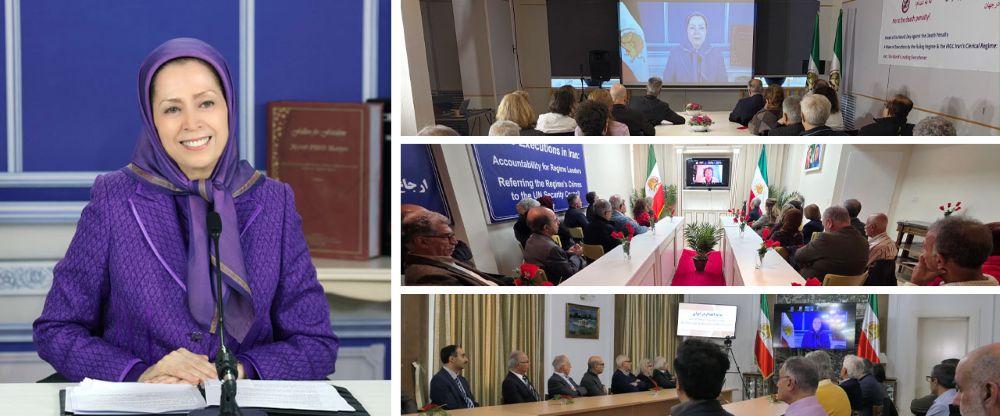
Three days ago, in a letter to the Secretary-General of the United Nations, I called on the UN to lead an international initiative to compel the regime to stop executions, killings, and crimes against humanity, including:
1. Recognizing the 1981 executions, the 1988 massacre, and the killings of protesters in 2019, 2022, and 2026 as genocide and crimes against humanity.
2. Compelling the Iranian regime to immediately stop executions—especially of political prisoners—and end the killing of protesters through effective political, legal, and diplomatic actions, including making the end of executions a condition in any international agreement with Iran.
3. Creating an independent international criminal justice mechanism through the UN General Assembly to investigate, collect evidence, identify those responsible for international crimes in Iran, and hold them accountable.
4. Ending impunity for regime leaders, including by prosecuting them in national courts based on the principle of universal jurisdiction.
5. Referring the grave violations of human rights in Iran to the UN Security Council and referring cases of crimes against humanity and genocide—along with those who ordered and committed them—to the International Criminal Court and other competent international authorities.
6. Compelling the Iranian regime to grant full and free access to the Special Rapporteur on Iran, the independent Fact-Finding Mission, and other international experts to visit prisons, detention centers, victims, and witnesses of these crimes.
7. Calling on governments in the General Assembly, the Third Committee, the Human Rights Council, and other UN bodies to make economic, political, and diplomatic relations with Iran conditional on ending executions and stopping the killing of protesters.
I call on everyone to support these demands.