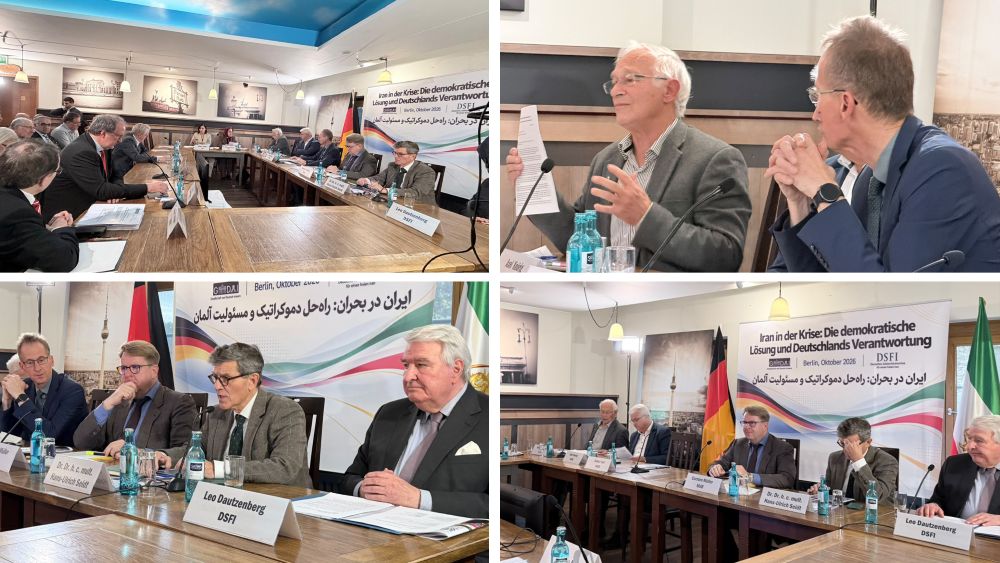
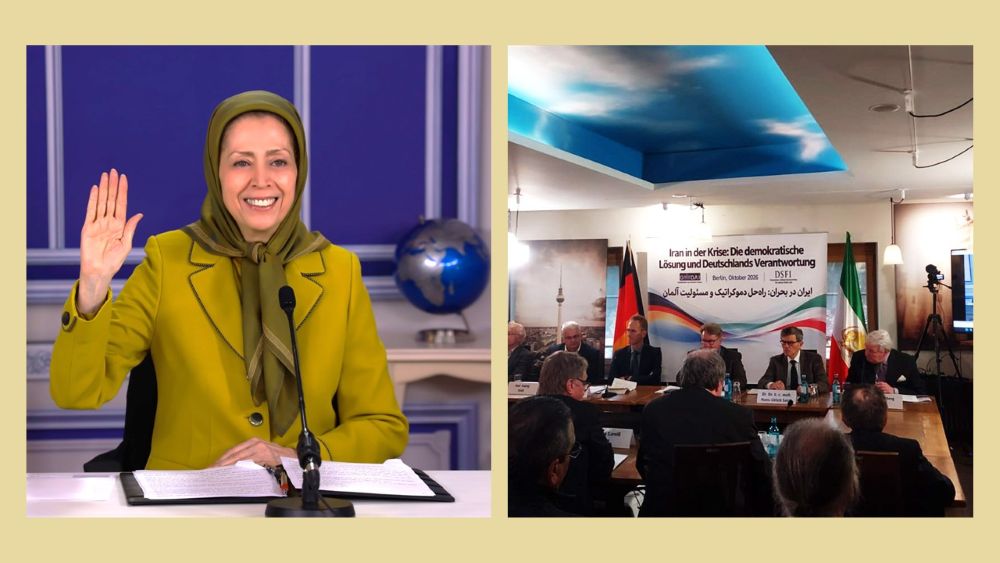
Mrs. Maryam Rajavi, the President-elect of the National Council of Resistance of Iran (NCRI), stated in a message to a conference in Berlin that the refusal to recognize the Iranian people’s resistance is the core failure of Western policy toward Iran. She said the clerical regime had chosen repression, regional intervention, warmongering, and terrorism over democracy and freedom, and that the struggle of the Iranian people against religious fascism was fundamental to ending the regime’s warmongering.
Mrs. Rajavi highlighted the regime’s deepening political and economic crisis, the execution of political prisoners and the issuance of death sentences against protesters, and the expanding resistance inside Iran. She rejected both appeasement of the clerical regime and the restoration of monarchical dictatorship as solutions to Iran’s crisis, emphasizing that the future of Iran must be determined by its people and their organized resistance.
Mrs. Rajavi called on Germany and the European Union to take decisive action to halt executions, hold Iranian regime officials accountable for crimes against humanity, close the regime’s embassy in Germany, and expel the operatives of the Islamic Revolutionary Guard Corps (IRGC) and the Ministry of Intelligence. She also urged the international community to recognize the Iranian people’s struggle to overthrow religious fascism and establish a democratic republic based on free elections and the separation of religion and state.
Message to Conference in Berlin: Iran crisis & democratic solution
For forty-seven years, a deep and protracted conflict has unfolded in Iran—one that constitutes the true battle, far eclipsing any external conflict. That is the war between the Iranian people and religious… pic.twitter.com/dUGRs19Xha— Maryam Rajavi (@Maryam_Rajavi) October 14, 2026
Read the full text of Maryam Rajavi’s message to the Berlin conference, “Iran Crisis and Democratic Solution,” here:
Message to Conference in Berlin: Iran Crisis and Democratic Solution
Maryam Rajavi: Refusal to Recognize Iranian People’s Resistance Marks Core Failure of Western Policy
Distinguished Members of the Federal Parliament, Esteemed Guests, and Respected Scholars,
This conference addresses a matter crucial to both the future of freedom and democracy in Iran and the peace and security of the world. For many years, the Iranian Resistance has consistently underscored the undeniable link between these two imperatives.
Two Choices Facing the Clerical Regime
From its inception, the clerical regime was confronted with two distinct paths. The first path was to rely on the immense energy liberated by the anti-monarchic revolution to advance progress, democracy, and independence for Iran—the very direction desired by the vast majority of the Iranian people.
The second path was to suppress this monumental force and turn toward regional intervention, warmongering, and terrorism that, for this regime, represent the flip side of domestic repression and a core component of its survival strategy.
Because this regime viewed freedom and democracy as an existential threat to its own survival, it chose the second path. Consequently, the struggle for freedom and human rights is not merely an internal Iranian affair; it is a vital prerequisite for ending the regime’s global warmongering.
For forty-seven years, a deep and protracted conflict has unfolded in Iran—one that constitutes the true battle, far eclipsing any external conflict. That is the fundamental war between the Iranian people and religious fascism.
Today, the remnants of the clerical regime are desperate to prolong the war. Khamenei’s son, who has inherited his position, has identified the continuation of war as the regime’s overarching strategic direction, using conflict as a shield against popular uprisings.
Meanwhile, the nation’s economy continues its downward spiral: one euro now trades at three million rials, more than double its value a year ago, with inflation reaching 73 percent and economic growth shrinking to negative 10 percent. Yet the clerics remain incapable of offering solutions, as they cannot curb their exorbitant expenditure on warmongering and domestic repression.
Executions and Systematic Pressure on Political Prisoners in Iran
Khamenei’s son sees but one solution: executing political prisoners and demonstrators who took to the streets.
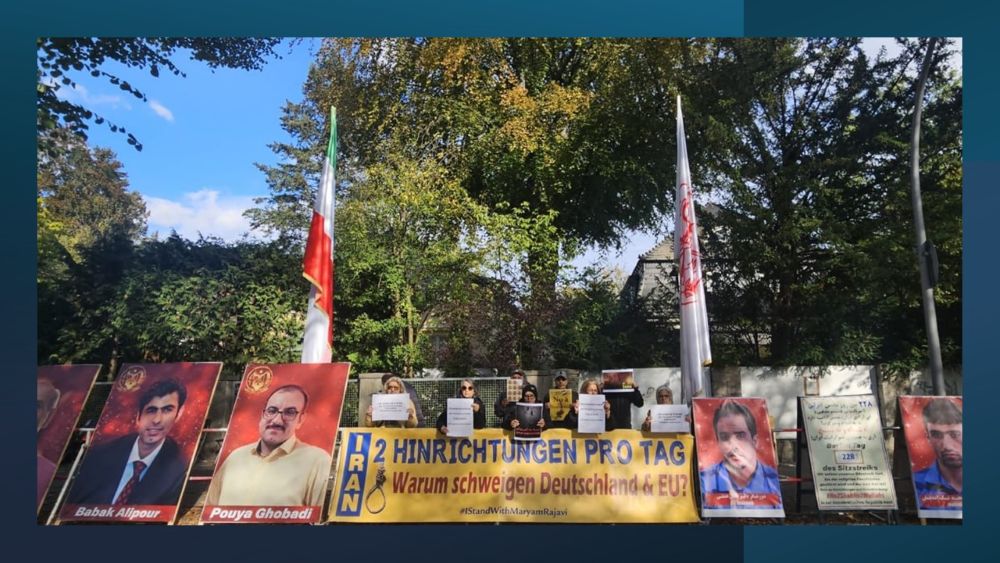
Since the very first weeks of this war, at least 46 political prisoners have been executed, including nine members of the People’s Mojahedin (PMOI/MEK). Death sentences continue to be handed down to scores of other political detainees.
Among the most recent cases is Amir-Hassan Akbari-Monfared, a 23-year-old student sentenced to death over alleged membership in the PMOI. Before him, Zahra Tabari, an engineer, was condemned to death by a sham court in Rasht on similar charges of PMOI affiliation and activism, while 25-year-old Arghavan Fallahi received a death sentence following months of brutal torture in Tehran.
Inside Iran’s prisons, detained protesters are subjected to intense, inhumane psychological and physical pressure.
The loss of Syria, the death of Khamenei, deep fractures within the ruling elite, financial insolvency and collapse, and above all, the imminent threat of popular uprisings have placed the clerics in a fatal predicament. Their crisis is not merely that they cannot sustain the status quo; it is that they are fundamentally incapable of charting a new course.
The very conditions that triggered the January 2026 uprising have escalated exponentially. Public defiance and resistance, led particularly by the younger generation standing up to the Revolutionary Guard Corps, continues to expand. Over recent months, Resistance Units have significantly intensified their strikes against regime installations and defiance of their state apparatus.
Indeed, no matter which path the clerics choose, they cannot escape widespread uprising and ultimate overthrow.
Two Flawed Pillars of Western Policy
For many years, the policy of Germany and other European Union member states regarding Iran rested on two fundamental assumptions:
First, an illusory hope that the monster of religious tyranny in Iran would eventually be tamed and that a way could be found to accommodate it.
Second, a misguided strategy premise that the Iranian problem could be resolved while ignoring the Iranian people and their organized resistance.
Events have proven both assumptions utterly wrong. Appeasement produced war.
Meanwhile, consecutive uprisings and the expanding network of Resistance and Resistance Units have made one truth clear: the decisive force shaping Iran’s future is the Iranian people and their organized resistance.
The core failure of Western policy toward Iran to this day has been the refusal to recognize the Iranian people’s resistance.
The National Council of Resistance of Iran (NCRI) fights for a democratic republic grounded in free elections and the separation of religion and state.
The media frenzy surrounding the remnants of the Shah’s monarchy cannot alter this outcome. He represents a false alternative that undermines the Iranian people’s democratic movement and, in practice, serves the regime’s interests.
To the Iranian people, he remains a symbol of foreign dependency and an attempt to restore monarchical dictatorship. By openly declaring pride in everything his father did, he offers the clerics their greatest gift.
It was Britain that brought his grandfather to power, only to depose and exile him twenty years later during World War II, installing his son in his place. Likewise, in 1953, after the Shah fled the country, he was reinstated through a joint U.S.-British coup against the national government of Dr. Mohammad Mossadegh.
Yet, as the leader of the Iranian Resistance, Massoud Rajavi, stated: “The grand lesson of two wars and an uprising in 2025-2026 is that a return to puppet monarchical fascism is nothing more than a mirage.”
Message to Conference in Berlin: Iran crisis & democratic solution
Germany is among the nations fully empowered under the principle of universal jurisdiction to prosecute regime leaders in its own courts for crimes against humanity.
Furthermore, closing the regime’s embassy and… pic.twitter.com/DArK5LuuPp
— Maryam Rajavi (@Maryam_Rajavi) October 14, 2026
Call to Stop Executions in Iran
Now is the time for Germany and the European Union to stand firmly with the people of Iran. A few days ago, on the eve of the World Day Against the Death Penalty, I presented a 7-point plan calling on the United Nations and its member states to take decisive action to halt human rights violations in Iran.
These measures include:
1. Formally recognizing the mass executions of 1981, the 1988 massacre, and the slaughter of protesters during the uprisings of 2019, 2022, and 2026 as acts of genocide and crimes against humanity.
2. Compelling the Iranian regime to immediately halt all executions, particularly of political prisoners and protesters, through effective political, legal, and diplomatic measures, including making the cessation of executions a mandatory condition in any international agreement involving Iran.
3. Establishing an independent international criminal justice mechanism through the United Nations General Assembly to investigate, gather evidence, identify perpetrators, and hold accountable those responsible for international crimes committed in Iran.
4. Ending impunity for regime leaders, including through prosecution in national courts under the principle of universal jurisdiction.
5. Referring the grave record of human rights violations in Iran to the United Nations Security Council and turning over dossiers on crimes against humanity and genocide, along with those who ordered and committed them, to the International Criminal Court and other competent international tribunals.
6. Compelling the Iranian regime to grant unimpeded access for the Special Rapporteur on the situation of human rights in Iran, the Independent International Fact-Finding Mission, and other independent international mechanisms and experts to prisons, detention centers, victims, and witnesses of these crimes.
7. Calling upon governments in the UN General Assembly, the Third Committee, the Human Rights Council, and other United Nations bodies to strictly condition all economic, political, and diplomatic relations with the Iranian regime on an immediate end to executions and the killing of protesters.
Germany is among the nations fully empowered under the principle of universal jurisdiction to prosecute regime leaders in its own courts for crimes against humanity.
Furthermore, closing the regime’s embassy and expelling the overt and covert operatives of the Revolutionary Guard Corps (IRGC) and the Ministry of Intelligence from German soil must no longer be delayed.
Most crucially, the international community must formally recognize the Iranian people’s fight to overthrow religious fascism and the legitimate struggle of rebellious youth against the criminal IRGC.
In closing, I express my sincere appreciation to the Solidarity Committee for a Free Iran and the Association of Iranian Communities in Germany for convening this conference.