



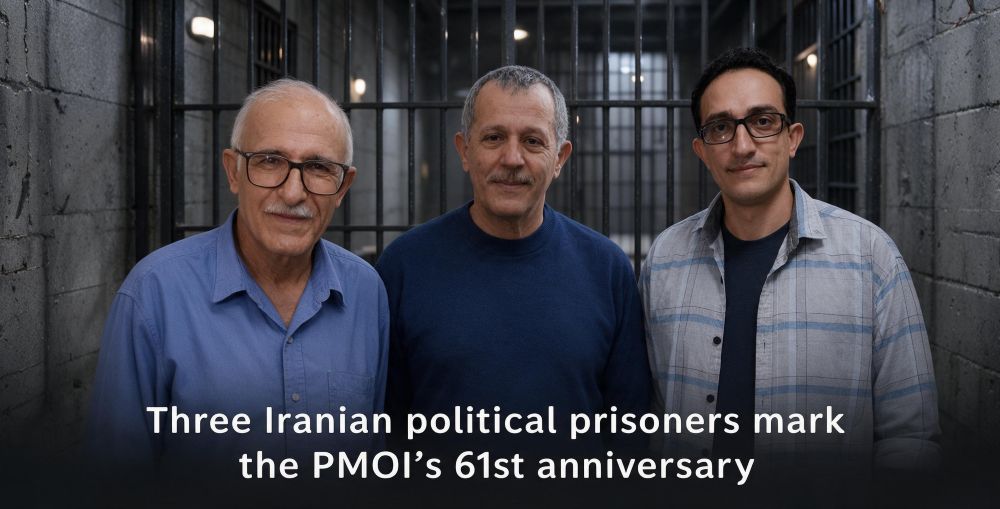
Three Iranian political prisoners, Ali Moezzi, Khosrow Rahnama and Sepehr Emamjomeh, have sent messages from Ghezel Hesar Prison marking the 61st anniversary of the founding of the People’s Mojahedin Organization of Iran (PMOI/MEK) on September 6, 2026. Their messages reflect on the organization’s history, organized resistance, political struggle, and the future of Iran.
Ali Moezzi: “Let us not allow others to write our destiny”
In his message from Ghezel Hesar Prison, Ali Moezzi marks the 61st anniversary of the PMOI by reflecting on what he describes as the organization’s six decades of struggle against dictatorship and dependence.
Moezzi refers to the PMOI as having developed from a “sapling” planted in September 1965 into “a mighty tree and a steadfast support for the people of Iran.” He traces this history through different stages of the organization’s activities, including its opposition to the Shah, the post-revolution period, the National Council of Resistance of Iran, the National Liberation Army, Ashraf, the emergence of women in leadership, and the Resistance Units.
Addressing Iran’s present situation, Moezzi writes: “Let us not allow others to write our destiny.” He places particular emphasis on the relationship between organized resistance and popular participation, writing: “Organized resistance needs the masses, and the unorganized masses need this organized resistance.”
He concludes his message with calls for freedom, democracy and equality and the slogan: “Death to the oppressor, whether the Shah or the Supreme Leader.”
Khosrow Rahnama: “Only organized revolutionary resistance”
Khosrow Rahnama’s message from Ghezel Hesar Prison begins with a renewal of his pledge to the PMOI on the anniversary of its founding. He places the organization’s 61-year history within a broader account of Iran’s political struggles, referring to the Constitutional Revolution, the Jungle Movement, the national movement led by Mohammad Mossadegh, and the 1979 revolution.
Rahnama writes that the experience of the past century demonstrates the importance of a national and revolutionary organization capable of confronting dictatorship. He identifies organized resistance with the PMOI and its Resistance Units and refers to their role in the ongoing political struggle.
A central line of his message reads: “For the Iranian regime, no name is redder and more terrifying than ‘Mojahed-e Khalq.’”
Rahnama closes his message by rejecting both the monarchical and clerical systems, writing: “Death to reactionary regimes, whether the mullahs or the Shah.” He also sends a salute to the Resistance Units and the Army of Peace and Freedom.
Sepehr Emamjomeh: “Who would write the future and destiny?”
Sepehr Emamjomeh’s message is structured around a series of questions about the role of the PMOI in different stages of Iran’s modern political history.
Beginning with the question, “What would have happened if it had not existed?”, Emamjomeh refers to several historical developments, including the PMOI’s opposition to Khomeini after the 1979 revolution, the National Liberation Army and the Iran-Iraq War, the role of women under Maryam Rajavi, the organization’s internal revolution, the political alternative, and the Resistance Units.
He then asks: “If organized resistance and its steel-strong organization did not exist, who would write the future and destiny?” His message also connects the existence of the Resistance Units with the emergence of uprisings and raises questions about Iran’s political future and sovereignty.
In the final part of his message, Emamjomeh reflects on his own circumstances and asks where he and others would be without what he describes as “61 years of history and experience of relentless struggle.”
He concludes by marking the 61st anniversary of the PMOI and writes: “Long live the new democratic revolution of the Iranian people.”
The three messages, issued from Ghezel Hesar Prison, mark the 61st anniversary of the PMOI through three distinct perspectives: Moezzi’s focus on continuity and the connection between organized resistance and society, Rahnama’s emphasis on organized revolutionary resistance, and Emamjomeh’s series of questions about the organization’s historical role and Iran’s political future.