



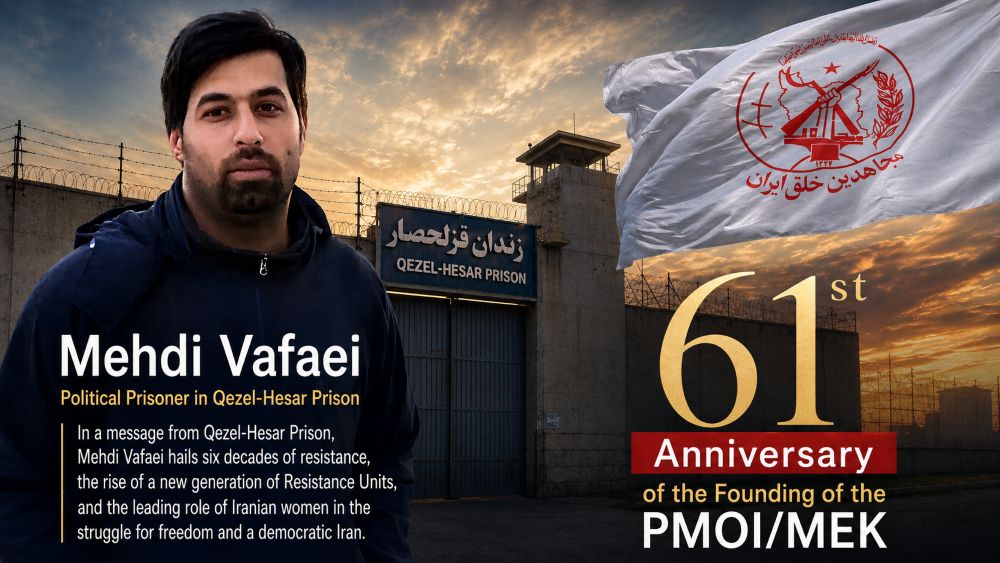
Political prisoner Mehdi Vafaei hails six decades of resistance and the rise of a new generation of Resistance Units behind Iran’s prison walls
September 2026 — Qezel-Hesar Prison, Iran: Political prisoner Seyed Mehdi Vafaei has issued a message from Qezel-Hesar Prison marking the 61st anniversary of the founding of the People’s Mojahedin Organization of Iran (PMOI/MEK). In his message, he pays tribute to more than six decades of organized resistance against dictatorship in Iran, highlights the emergence of a new generation of resistance supporters and Resistance Units inside the country’s prisons, and underscores the leading role of Iranian women in the struggle for freedom.
Addressing the “heroic people of Iran,” Vafaei describes the more than 60-year history of the PMOI/MEK as a “complete and eloquent book” of bloody struggle. He emphasizes that, unlike movements that eventually become part of history and disappear from the political scene, the organization has continued to evolve from within itself, sustaining its struggle through successive generations and despite immense sacrifices.
“If I am to speak of the many long years of struggle in history, it is enough to look at more than 60 years of the Mojahedin’s bloody struggle,” he writes. “It is a complete and eloquent book.”
Vafaei says the organization has paid an immeasurable price throughout this historic struggle, describing its sacrifices as extending across the history of the past and into the future.
A New Generation of Resistance Behind Prison Walls
Vafaei then turns to the experience of political prisoners and resistance supporters inside Iran’s prisons. He points out that many of the supporters and Resistance Units currently imprisoned had never been part of the organizational structures of the PMOI/MEK. Nevertheless, he says, they are standing firm and developing with a striking resemblance to the organizational spirit of the Mojahedin and with a resistance reminiscent of the Sarbedaran of 1988.
“Most of the supporters and Resistance Units who are in prison, although they have never been part of the Mojahedin’s organization, are standing and growing with an astonishing resemblance to the Mojahedin’s organizational spirit and with a resistance similar to that of the Sarbedaran of 1988,” he states.
According to Vafaei, the emergence and growth of such individuals has left the regime’s security apparatus bewildered. He poses a fundamental question: How can an organization that has been physically separated from the current of Iranian society, undergone multiple generational changes, and endured countless hardships and tragedies continue to inspire people prepared to sacrifice everything they have?
“How is it possible that the organization, while physically separated from the current of Iranian society and through multiple generational changes and countless difficulties and tragedies, can raise such tall cypresses who give up everything—their family and all else?” he asks.
Vafaei contrasts this resilience with the enormous resources at the disposal of the ruling regime. He points to the regime’s control over information, wealth, media, and even people’s religious beliefs, while stressing that the regime remains unable to extinguish the determination of these courageous men and women.
Iranian Women at the Forefront of the Struggle
A central part of Vafaei’s message is his tribute to the courageous women of Iran. He describes Iranian women as being consistently at the forefront of the struggle, drawing strength and inspiration from what he calls the “revolution of Sister Maryam.”
“Iranian women, relying on the revolution of Sister Maryam, are always on the front line of the struggle, and with complete liberation, they are opening the way,” he writes.
The message echoes the broader emphasis of the Iranian Resistance on the pivotal role of women in confronting religious dictatorship and leading the struggle for freedom. The leadership role of Iranian women and their presence at the forefront of resistance activities are recurring themes in the movement’s English-language publications.
A Struggle Carried from the Past Toward the Future
For Vafaei, the developments inside Iran’s prisons are not isolated events but part of a continuing historical process. He sees the growth of new resistance forces as evidence that the struggle has not merely survived repression but has continued to expand and produce new generations of committed individuals.
“This was a summary of the past, the present, and the path toward the future,” he writes. He expresses confidence that, with the further growth and multiplication of resistance forces, a new path will be opened in the history of the world.
He concludes his message with a salute to Massoud and Maryam and a declaration of support for a proud Iran and the People’s Mojahedin Organization of Iran:
“Salutations to Massoud and Maryam. Long live Iran. Long live the People’s Mojahedin Organization of Iran.”
Vafaei then closes with a poem expressing perseverance, sacrifice, and hope in the face of hardship:
“I said: This is a beginning that has no end;
If love is love, it knows no easy path.
You said: We must travel from autumn,
Though the flower cannot withstand the storm.”
Signed by Seyed Mehdi Vafaei, the message was issued in September 2026 from Qezel-Hesar Prison.