



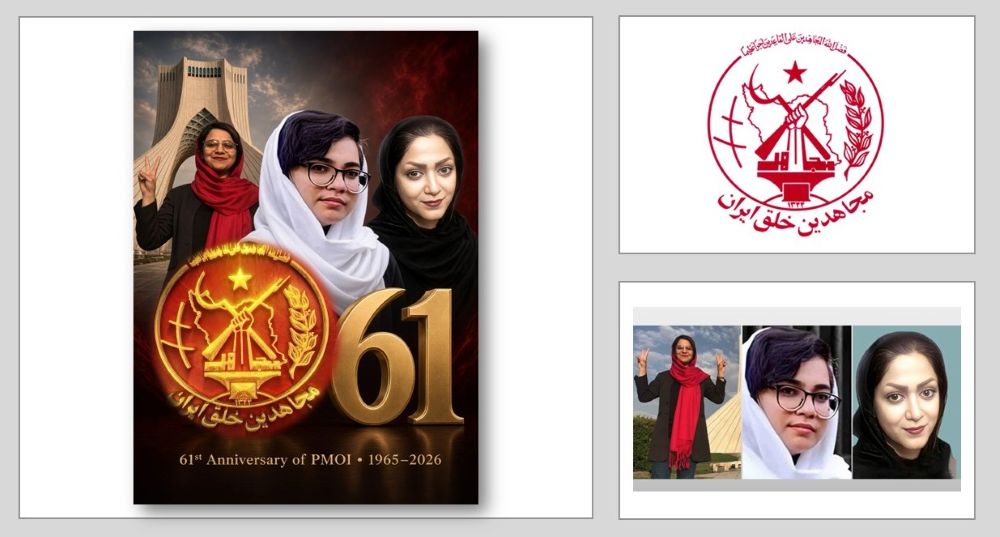
Iranian Political prisoners Arghavan Fallahi and Forough Taghipour in Evin Prison and Parisa Kamali in Yazd Central Prison have issued separate messages marking the 61st anniversary of the founding of the People’s Mojahedin Organization of Iran (PMOI/MEK), expressing their continued commitment to freedom, justice, and opposition to dictatorship.
Fallahi and Taghipour sent their message from Evin Prison in Tehran, while Kamali issued hers from Yazd Central Prison. Their statements also coincided with commemorations by political prisoners and supporters of the Resistance in Tabriz and Karaj.
Messages from Evin Prison
In their message from Evin, Arghavan Fallahi and Forough Taghipour extended greetings to the Iranian people, Resistance Units, Maryam and Massoud Rajavi, and MEK members in Ashraf.
Writing from behind the walls of Evin Prison, the two prisoners said they wanted their message to reach Iran’s youth and people despite the restrictions imposed on political prisoners.
They referred to the founders of the MEK—Mohammad Hanifnejad, Saeed Mohsen, and Ali Asghar Badizadegan—who established the organization in September 1965. Describing themselves as part of the founders’ political legacy, they said the organization had continued its struggle through six decades.
Fallahi and Taghipour described the MEK as an organization that challenged what they characterized as outdated and reactionary political and social ideas. They portrayed its history as a struggle against both the former monarchy and the current clerical regime, emphasizing opposition to dictatorship as a central element of their political commitment.
The two prisoners also referred to the role of resistance and organization inside Iran, including in prisons such as Evin and Qezel Hesar, as well as among communities outside the country.
A significant part of their message focused on people they described as having sacrificed their lives for the Resistance. They referred to the victims of the 1988 massacre of political prisoners and to younger members of the Resistance, including Babak Alipour, Vahid Banian Amerian, Pouya Ghobadi, and Mehdi Khanaki.
The prisoners said that mourning the loss of such individuals would not weaken their determination. Instead, they described the memory of those who died as a source of continued resolve.
Fallahi and Taghipour also condemned what they described as increased executions and repression by the Iranian regime. They wrote that imprisonment and executions could not extinguish their political convictions.
They concluded their message by marking the 61st anniversary as a continuation of the organization’s history and expressing support for what they described as a new democratic republic in Iran.
Parisa Kamali’s Message From Yazd Prison
Parisa Kamali, a political prisoner held in Yazd Central Prison, also marked the anniversary with a message describing the MEK’s six decades of history as a path of sacrifice, perseverance, and commitment to freedom and justice.
Kamali said her commitment to freedom and resistance was rooted in the MEK and its history. Referring to the organization’s founders, she credited Mohammad Hanifnejad, Saeed Mohsen, and Asghar Badizadegan with establishing the MEK on September 6, 1965, and credited Massoud Rajavi with preserving the organization through successive periods of repression.
Kamali described the organization’s history as one of resistance to both monarchical and clerical forms of dictatorship. She also associated its stated principles with freedom, justice, and a prosperous Iran.
Writing from prison, Kamali said the MEK had helped her understand what she described as political realities and had given her hope. She expressed her continued adherence to the organization’s principles despite her imprisonment.
She concluded by congratulating freedom-seekers and those committed to independent thought, expressing the hope that the anniversary would be celebrated by “awakened consciences” and freedom-loving and free-thinking people.
Commemorations in Tabriz and Karaj
The 61st anniversary was also marked in Tabriz and Karaj.
In Tabriz, political prisoners supporting the MEK presented a floral wreath featuring an image of Mohammad Hanifnejad and the inscription “61 Years of Boundless Sacrifice.”
In Karaj, political prisoners supporting the Resistance presented a basket of flowers featuring images of the organization’s founders and carrying the slogan “61 Years of Perseverance.”
The messages from Fallahi and Taghipour in Evin and Kamali in Yazd, together with the commemorations in Tabriz and Karaj, marked the 61st anniversary of the founding of the PMOI/MEK from inside Iranian prisons and through supporters in different cities.
The prisoners’ statements emphasized themes of freedom, justice, resistance, sacrifice, and opposition to dictatorship, while reaffirming their stated commitment to continuing the struggle despite imprisonment.