


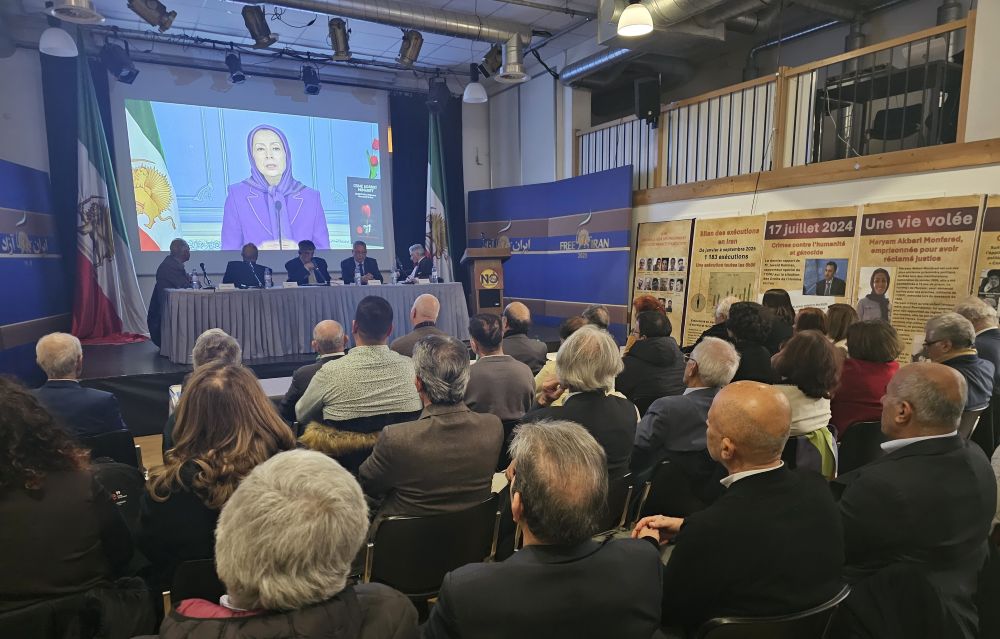
A high-level international conference held in Geneva on November 20, 2025, issued an urgent call for the United Nations Security Council to take up Iran’s human rights dossier. Convened amid a sharp rise in state-sanctioned executions and following a landmark UN Third Committee resolution, the gathering brought together European lawmakers, former UN rapporteurs, legal experts, and Iranian activists. Speakers denounced Tehran’s “killing machine” and emphasized that appeasement has failed, advocating instead for a “Third Option”: supporting the Iranian people and their organized resistance.
Maryam Rajavi: A Regime at War with Its Own People
In her keynote address, Maryam Rajavi, President-elect of the National Council of Resistance of Iran (NCRI), described Iran’s execution surge as part of a strategic war by a fragile dictatorship. She revealed that 1,650 executions have taken place in 2025 alone, with thousands more at risk, including political prisoners such as Zahra Tabari and Mohammad Javad Vafaei Sani.
Mrs. Rajavi welcomed the UN Third Committee’s recent resolution referencing the 1988 massacre and connected it to former UN Special Rapporteur Javaid Rehman’s 2024 report classifying the killings as genocide. She stressed that repression, regional destabilization, and nuclear expansion constitute a unified strategy of the regime.
Calling for decisive international action, Mrs. Rajavi demanded that the UN free human rights mechanisms from “commerce and appeasement,” refer Iran’s human rights case to the Security Council, and secure access for UN officials to Iranian prisons. She concluded with a stark warning: the fate of notorious prisons like Evin will mirror the downfall of brutal institutions worldwide.

Expert Testimony: Evidence of Atrocity Crimes
Professor Javaid Rehman
Former UN Special Rapporteur Javaid Rehman described 2025 as the most violent year since 1988. He cited over 1,500 executions and highlighted the July 27 execution of political prisoners Mehdi Hasani and Behrouz Hassani. He condemned Tehran’s destruction of evidence, noting the conversion of the 1988 massacre’s mass grave into a parking lot.
Rehman urged the creation of an international accountability mechanism, declaring that the regime has “weaponized the death penalty” to eliminate dissent.

The Opening Address: Jean-Charles Rielle
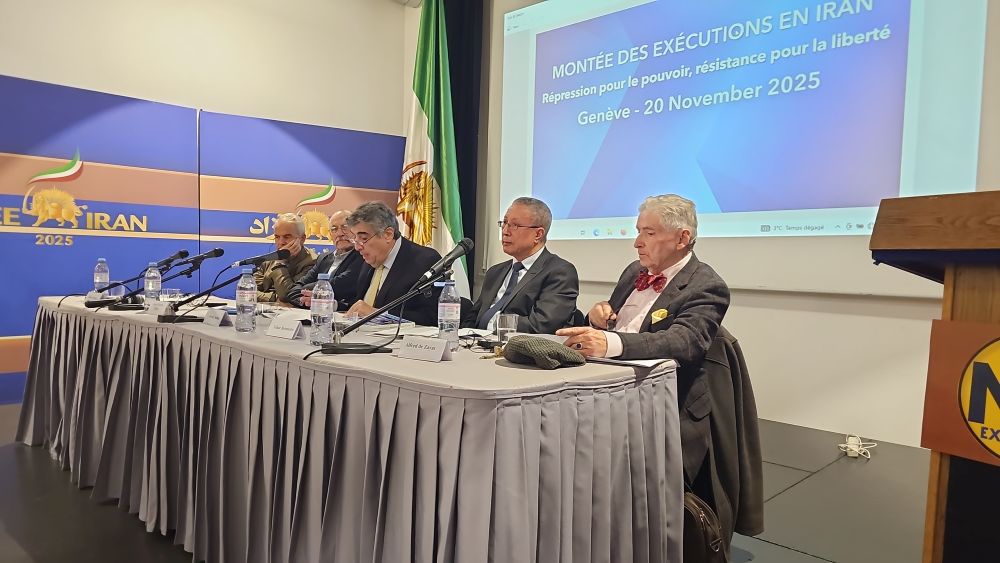
Former President of the Grand Council of Geneva Jean-Charles Rielle emphasized Geneva’s symbolic role in defending human rights. He condemned the executions as political terror and called for diplomatic pressure, sanctions, and an immediate UN mission to inspect Iranian prisons, especially those holding women.
Legal Mechanisms for Justice: Alfred de Zayas
Former UN Independent Expert Alfred de Zayas outlined legal avenues to bypass geopolitical paralysis. He argued that Iran’s ongoing crimes qualify for prosecution by the International Criminal Court (ICC) under Article 7 and strongly advocated using universal jurisdiction. Winning the “information war,” he said, is essential to counter Tehran’s narrative.
Tahar Boumedra: A Pathway to Accountability
Tahar Boumedra, former head of UNAMI’s Human Rights Office, hailed the UN Third Committee’s new resolution for naming the IRGC and judiciary as perpetrators. He warned that Khomeini’s 1988 fatwa remains in force and stressed the need to identify perpetrators through universal jurisdiction mechanisms.
Yesterday the UNGA Third Committee adopted a resolution on the human rights situation in Iran which, for the first time, references the #1988Massacre, the first official acknowledgement by the global community of those crimes against humanity.
It's time to end impunity in Iran. https://t.co/G0aHsZTORe pic.twitter.com/m4Q8oSWYYJ
— Justice for the Victims of 1988 Massacre in Iran (@jvmifoundation) November 20, 2025
Rémy Pagani: Historical Parallels and Civil Responsibility
Former Geneva Mayor Rémy Pagani compared Iran’s execution apparatus to Nazi tactics, calling the death penalty a tool of political control. He emphasized civil society’s duty to break the silence surrounding political prisoners and warned of the regime’s expansionist ambitions.
Laurence Fellman Rielle: Failures of Silent Diplomacy
Swiss MP Laurence Fellman Rielle criticized behind-the-scenes diplomacy, noting 37 women and several minors among Iran’s 1,650 execution victims in 2025. She highlighted the central role of women in the resistance and supported the “No to Executions Tuesdays” campaign in 54 prisons. She called for a UN inspection mission, especially for women’s prisons like Qarchak.
Simay Azadi’s exclusive interview with Swiss lawmaker @FehlmannRielle. “Switzerland should put pressure on the Iranian regime to stop executions.” pic.twitter.com/lAvmfyNZrO
— SIMAY AZADI TV (@en_simayazadi) November 22, 2025
Jeremy Sarkin: Death Penalty and Enforced Disappearances
Former UN Working Group Chair Jeremy Sarkin noted that while 130 nations support a moratorium on executions, Iran has intensified them. He described capital punishment in Iran as “state violence” and defined enforced disappearance as a continuous crime—one Iran continues through concealing 1988 burial sites.
Exclusive – On the sidelines of today’s conference in Geneva on human rights in Iran, Prof. Jeremy Sarkin, former UN Chair-Rapporteur, told Simay Azadi: “The 1988 massacre remains on the minds of many people. It’s time for the international community to step up its activities,… pic.twitter.com/VwjsfrpMPA
— SIMAY AZADI TV (@en_simayazadi) November 20, 2025
Voices from Inside the Resistance
Hossein Imani Nejad
Engineer and activist Hossein Imani Nejad argued that the regime fears a popular uprising backed by organized resistance more than war or sanctions. He said the 1,500 executions in 2025 represent the regime’s “last weapon” to maintain power and accused Tehran of masking political executions as drug or espionage cases.
🌐Tribune de Genève
🥀 The alarming rise of executions in IranI was interviewed as a part of this report and grateful that our message is reaching the public.#1988Massacre#StopExecutionsInIranhttps://t.co/epNY4sVR1B
Merci @ThéophileSimon pour ton travail remarquable
— Hossein Imani (@Hossein_Imani1) November 24, 2025
Neda Amani
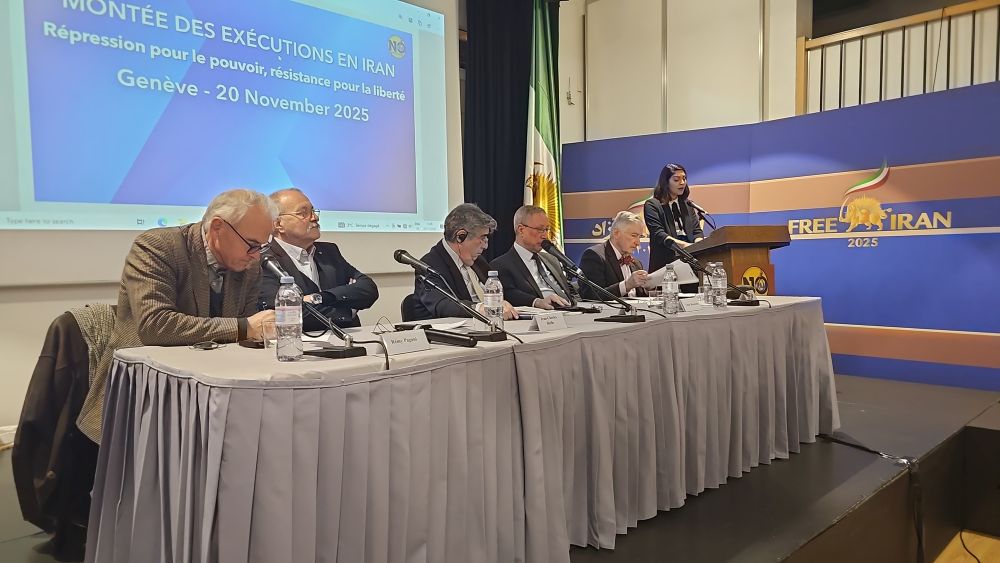
Moderator Neda Amani, representing young Iranians in Switzerland, endorsed the NCRI’s demand for Security Council action. She praised the decades-long efforts of the Iranian Resistance in documenting crimes and advocated immediate referral of the case to the UN.
A good day in Iranian history thanks to the tireless work of the Iranian Resistance. A big step forward in bringing those responsible for the 1988 massacre to justice. May the souls of the martyrs of 1988 rest in power ✊♥️#1988Massacre #StopExecutionsInIran https://t.co/53FB76xrpA
— Neda Amani (@NedaAmani_CH) November 19, 2025
The Third Option: A Path Forward
The conference concluded with a unified message: appeasement has emboldened Iran’s machinery of repression, and international engagement must shift. Speakers urged:
-
Referral of Iran’s human rights dossier to the UN Security Council
-
Activation of universal jurisdiction to prosecute regime officials
-
Support for Iran’s democratic opposition and the broader “Third Option” strategy
With execution numbers surging and atrocities continuing from 1988 to 2025, the Geneva conference asserted that a democratic republic in Iran is the only viable path to stability, justice, and human rights.