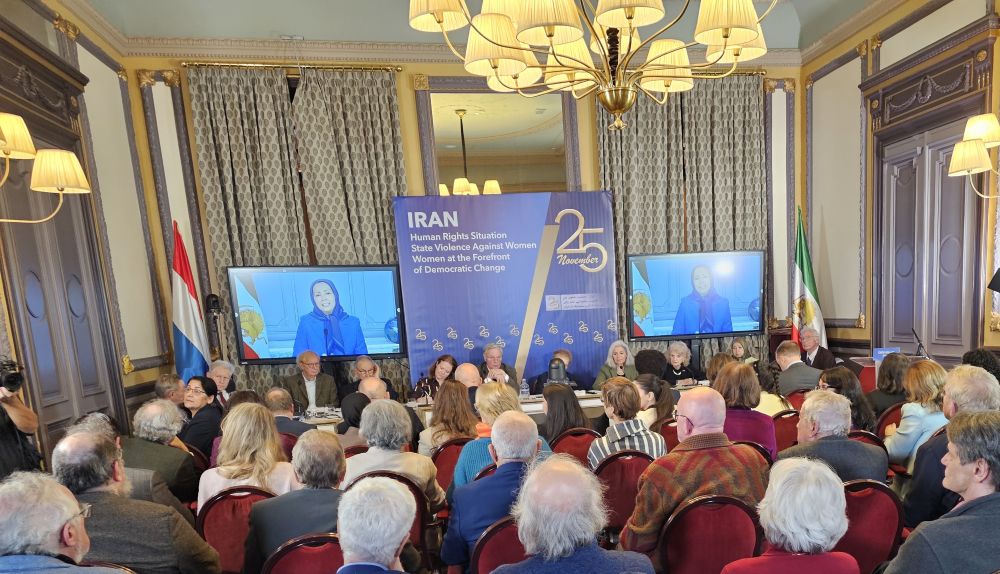
On November 25, 2025, coinciding with the International Day for the Elimination of Violence against Women, a major international conference was held in The Hague to address the worsening human rights situation in Iran. European ministers, parliamentarians, legal experts, and human rights advocates gathered to denounce the rise in executions, systemic violence against women, and repression of political dissent. The event also highlighted the central role of Iranian women in the struggle for a democratic republic.
Maryam Rajavi: Political Repression Is the Regime’s Greatest Violence Against Women
Mrs. Maryam Rajavi, President-elect of the National Council of Resistance of Iran (NCRI), delivered the keynote address. She described the clerical regime as the “worst enemy of women,” emphasizing how forced veiling, discriminatory laws, and state violence have institutionalized misogyny. She reported that at least 53 women had been executed in 2025, and pointed to the deaths and torture of female political prisoners, including the recent death of Somayeh Rashidi and the looming execution of Zahra Tabari.
Despite the brutality, Mrs. Rajavi praised Iranian women for transforming themselves from victims into leaders of the nationwide resistance. She reiterated the NCRI’s vision for a future Iran based on gender equality, abolition of the death penalty, separation of religion and state, and a non-nuclear democratic republic. She urged European governments to condition relations with Tehran on halting executions and to designate the IRGC as a terrorist organization.
Dorien Rookmaker: Iranian Women Are Warriors, Not Victims
Conference moderator Dorien Rookmaker, former Member of the European Parliament, opened the event by framing the Iranian women’s struggle as a broader fight against dictatorship. Rejecting the view that the movement focuses solely on the hijab, she said the Iranian people oppose both the current theocracy and the return of monarchy. She praised Rajavi’s Ten-Point Plan as a roadmap for freedom, calling Iranian women “warriors” who lead protests and endure torture.
I am pleased to announce that Maryam Rajavi, the president-elect of the joint opposition in Iran, graciously joined us as a key note speaker at the conference held today in the Hague. In attendance were numerous Dutch senators, members of parliament, scientists, and international… https://t.co/a5TmP25ePA
— Dorien Rookmaker (@RookmakerDorien) November 25, 2025
European Legal and Political Leaders Call for Firm Action
Former German Justice Minister Prof. Dr. Herta Däubler-Gmelin condemned Western inaction despite well-documented cases of torture and executions. She called for prosecuting regime officials in international courts, ending pressure on the Iranian Resistance in Europe, and recognizing the NCRI and its Ten-Point Plan.
Dutch Senator Frans van Knapen described the reports of Iran’s atrocities as “shocking,” praising the resilience of the Iranian diaspora and supporting women’s leadership in the struggle for a free Iran. Senator Boris Dittrich focused on the regime’s extraterritorial threats, citing assassinations of dissidents in the Netherlands and warning that Iran’s repression extends into Europe. He called for ending executions and for accountability.
Former Vice President of the Irish Senate, Catherine Noone, linked Iran’s systemic misogyny to oppressive religious traditions, praising Article 5 of the Ten-Point Plan, which ensures gender equality and freedom of dress. She urged European governments to blacklist the IRGC and condition relations on ending violence against women.
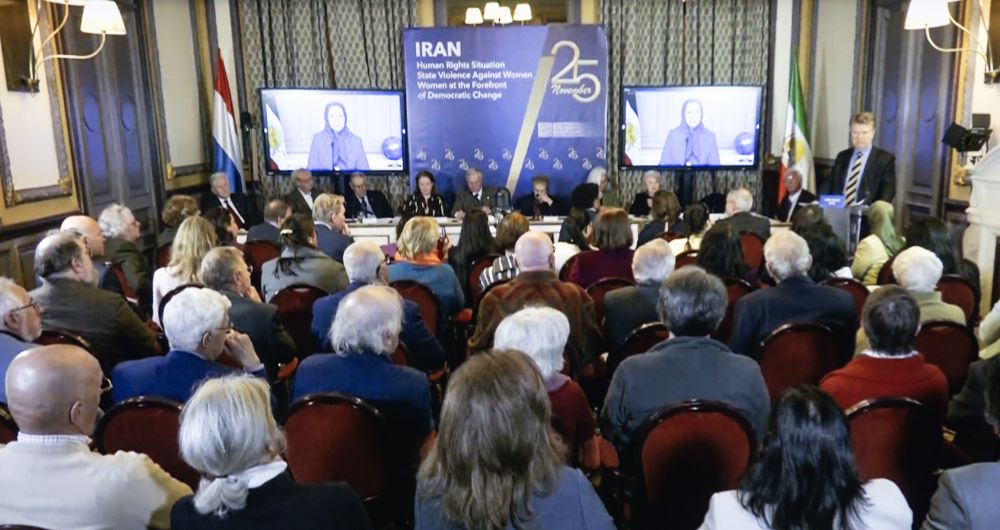
Corinne Dettmeijer, Vice-Chair of the UN CEDAW Committee, provided an alarming overview of women’s rights in Iran, noting child marriage, femicide, and the absence of legal protection. She condemned the death sentence against Zahra Tabari and highlighted the case of Maryam Akbari Monfared, who is denied medical care.
Dame Theresa Villiers, former UK Cabinet Minister, called Iran a “brutal misogynist regime,” citing laws enabling child marriage and punishing women for hijab violations. She highlighted the case of Zahra Tabari’s ten-minute trial as evidence of systemic cruelty, urging the UK to recognize the NCRI’s democratic alternative and proscribe the IRGC.
Advancing the ‘Third Option’ and International Accountability
Former Dutch Senator Kees de Lange advocated Maryam Rajavi’s “Third Option”: no to war, no to appeasement, yes to democratic change led by the Iranian people. He outlined a six-point plan calling for UN Security Council action, international arrest warrants for regime leaders, suspension of diplomatic ties until executions stop, and recognition of the NCRI.
Former Senator Bob van Pareren praised the organizational strength of the Iranian Resistance and the crucial role of women, arguing that a well-organized transition is essential for global security.
Dowlat Nowrouzi, NCRI Representative in the UK, reflected on decades of struggle and credited Rajavi with empowering Iranian women to stand at the forefront of resistance. She called on Europe to designate the IRGC as a terrorist entity.
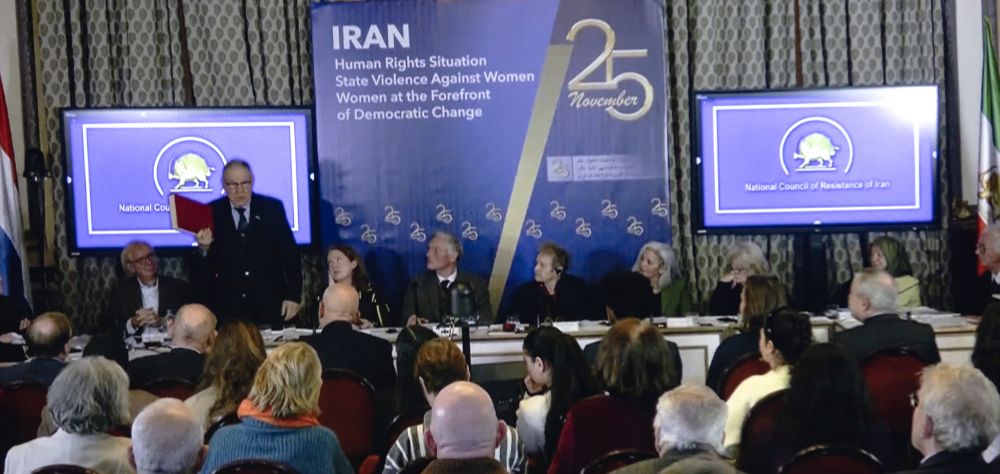
Former Dutch MP Prof. Dr. Henk de Haan criticized Western governments for allowing “oil capitalism” to overshadow human rights, holding up a book listing 20,000 victims of the regime. He endorsed the Ten-Point Plan as a foundation for a democratic Iran.
Iranian Activists: The Cost of Resistance
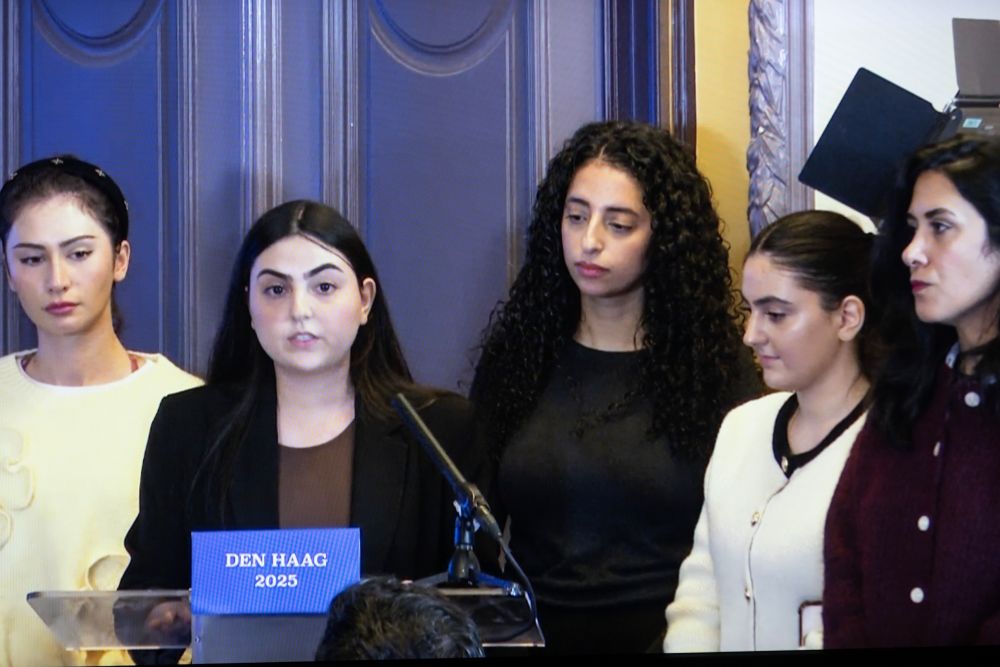
Iranian activists also addressed the gathering.
Dr. Arezoo Nasirlu described the “gender apartheid” imposed by the regime and highlighted the role of 1,000 NCRI women in Albania as models for resistance.
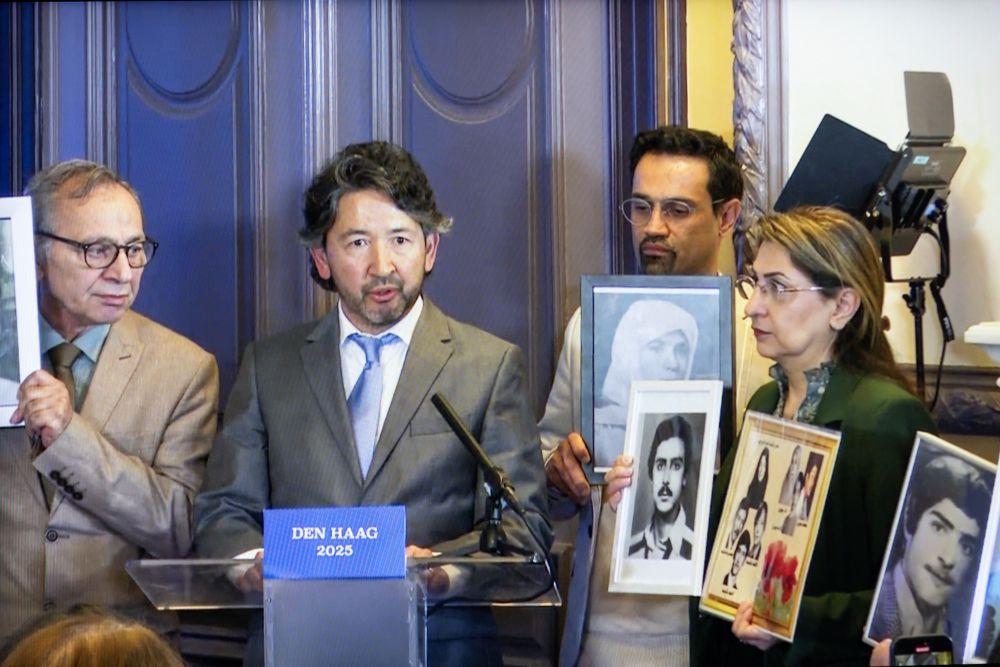
Reza Shayesteh recounted losing his mother, sister, and two brothers to the regime’s executioners, noting that the massacre of 120,000 political prisoners has not broken the movement. He called for prosecuting Khamenei and Judiciary Chief Mohseni Ejei.
Medical student Nahal Safa emphasized 39,000 acts of resistance by Resistance Units in the past year, honoring women who died in Camp Ashraf. Sepideh Orafa recalled the solidarity of women in the 1980s who defended those refusing the hijab.
A Unified Call for Democratic Change
Speakers across Europe and the Iranian diaspora unanimously condemned appeasement, demanded the IRGC be listed as a terrorist organization, and urged recognition of the NCRI’s Ten-Point Plan. The conference concluded with a shared message: the future belongs to a free and democratic Iran.