Human Rights Day Conference Highlights Urgent Need for EU Action
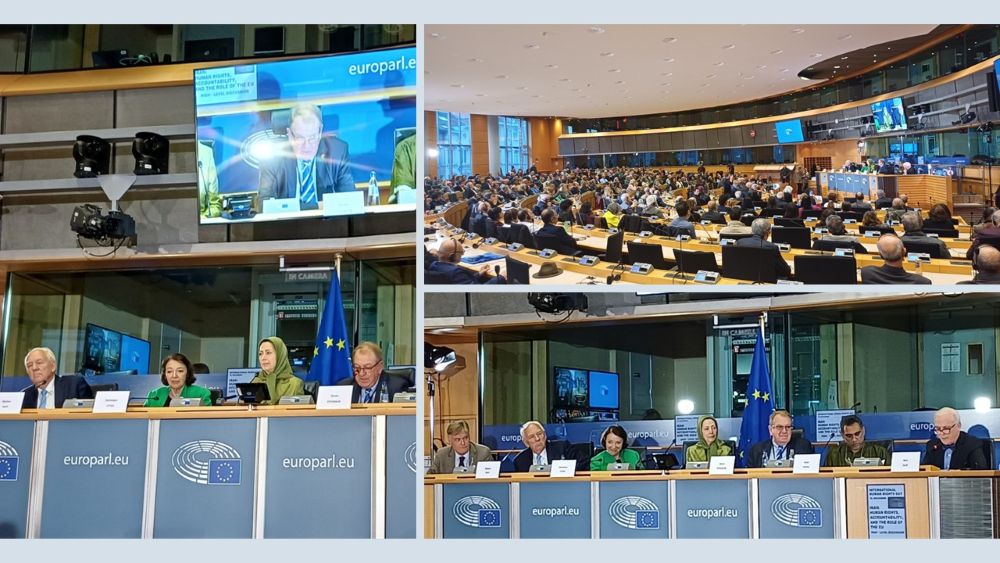
At a major International Human Rights Day conference in the European Parliament, lawmakers, legal experts, former ministers, and human-rights leaders condemned Iran’s accelerating executions and transnational repression.
Speakers emphasized growing global support for the NCRI, the rise of Resistance Units, and Mrs. Maryam Rajavi’s Ten-Point Plan for a democratic, secular republic.
They warned that the regime’s escalating violence reflects its weakening position and the emergence of an organized opposition capable of challenging its authority.
Start of the Second Conference in the European Parliament with Iran's opposition leader Maryam Rajavi #HumanRightsDay pic.twitter.com/9by32vhEu5
— Firouz Mahvi (@FirouzMahvi) December 10, 2025
Mrs. Maryam Rajavi: Iran’s Human-Rights Crisis at an Unprecedented Level
In her remarks, NCRI President-elect Mrs. Maryam Rajavi warned that Iran’s human-rights crisis has reached a historic peak. She cited 335 executions in November alone, and noted that the regime “hangs human rights every single day.”
She highlighted the cases of 18 political prisoners sentenced to death solely for supporting the PMOI and stated that the escalation of repression shows the regime’s fear of being overthrown.
Mrs. Rajavi stressed the expansion of Resistance Units across Iran, reflecting a nationwide desire to replace religious dictatorship with a democratic republic that rejects both the Shah’s and the mullahs’ autocracies.
She reiterated the Iranian people’s commitment to free elections, separation of religion and state, gender equality, the abolition of the death penalty, and the principles of the Universal Declaration of Human Rights.
Conference in the European Parliament on International #HumanRightsDay#StandUp4HumanRights pic.twitter.com/8dJfHepB7D
— Maryam Rajavi (@Maryam_Rajavi) December 10, 2025
Condemnation of Transnational Repression and Destruction of Evidence
Mrs. Rajavi condemned Tehran’s transnational repression, including the attempted assassination of former EP Vice-President Alejo Vidal-Quadras in Madrid and efforts to intimidate Iranian dissidents across Europe.
She warned that the destruction of 1980s mass-grave sites and efforts to erase evidence of the 1988 massacre constitute clear violations of international law.
Mrs. Rajavi outlined four urgent steps the EU must take:
-
End silence regarding human-rights atrocities, especially the death sentences of PMOI supporters.
-
Condition all relations with Tehran on an immediate halt to executions.
-
Close Iranian embassies and front organizations used for intimidation abroad.
-
Designate the IRGC and Ministry of Intelligence as terrorist entities.
She concluded that Iran faces “only one path—a democratic uprising leading to the overthrow of religious tyranny” and reaffirmed that the NCRI’s Ten-Point Plan remains the only viable framework for a free, democratic Iran.
The Second Conference in the European Parliament on International #HumanRightsDay
In Iran, the mullahs hang human rights every single day. Their record of horrific crimes does not need an annual review. This tragic dossier is open every day of the year, every hour of the day.
In… pic.twitter.com/ISXYNCsPpH— Maryam Rajavi (@Maryam_Rajavi) December 10, 2025
Struan Stevenson: Airstrikes Cannot Dismantle the Epicenter of Instability
Former MEP Struan Stevenson opened the conference with a firm assessment:
Airstrikes against Iran’s military or nuclear sites “cannot uproot the epicenter of instability—the clerical dictatorship in Tehran.”
He emphasized that PMOI Resistance Units are the only organized internal force capable of challenging state repression and praised the NCRI as the most coherent political coalition offering a credible transition plan.
He urged the EU to end appeasement, close Iranian embassies, expel intelligence networks, and finally blacklist the IRGC.
Ambassador Stephen Rapp: Execution Surge Amounts to Crimes Against Humanity
Former U.S. Ambassador-at-Large for Global Criminal Justice Stephen Rapp stated that Iran’s nearly 2,000 executions this year amount to crimes against humanity, echoing the pattern that culminated in the 1988 massacre of 30,000 political prisoners, most of them PMOI members.
Drawing on accountability models used for Syria, he said justice is achievable even without an international tribunal if Europe strengthens documentation and universal-jurisdiction prosecutions.
He stressed that past Western errors—such as labeling the PMOI as terrorists—must “never again” be repeated.
Former MEP Dorien Rookmaker: The Regime Is ‘100 Percent Pure Evil’
Dorien Rookmaker called the Iranian regime “100 percent pure evil” and urged European citizens to amplify the cases of political prisoners, including 17 PMOI supporters facing execution.
She advocated a Ten-Point Plan for the EU, which includes:
-
Universal-jurisdiction prosecutions
-
A UN-mandated tribunal for Iran
-
Conditioning relations on stopping executions
-
Formal endorsement of Mrs. Maryam Rajavi’s Ten-Point Plan as Iran’s democratic roadmap
Kumi Naidoo: Fear and Repression Reveal the Regime’s Weakness
Former Amnesty International Secretary-General Kumi Naidoo called for a six-point EU action plan, including an immediate moratorium on executions and mechanisms to investigate the 1988 massacre.
He condemned the death sentence against 67-year-old engineer Zahra Tabari for holding a “Woman, Resistance, Freedom” banner and praised Iranian women and Resistance Units as “the heartbeat of the nationwide struggle.”
Juan Fernando López Aguilar: Iran’s Crimes Contradict EU Legal Principles
Former Spanish Minister of Justice Juan Fernando López Aguilar argued that Iran’s mass executions and gender apartheid directly challenge the EU’s foundational legal commitments.
Though not endorsing any specific political movement, he stressed that European diplomacy must prioritize ending the death penalty and systemic repression.
MEP Antonio López-Istúriz White: Tehran’s Terror Extends Across Europe
López-Istúriz White highlighted Tehran’s expanding repression in Europe, referencing the assassination attempt on Alejo Vidal-Quadras.
He insisted that no normalization with Tehran is acceptable without major human-rights improvements and warned that Iran’s proxy networks—including Hezbollah—pose an increasing security threat that ultimately targets Europe.
IBA Director Mark Ellis: Impunity Strategy Mirrors 1988 Massacre
Mark Ellis presented findings from a new International Bar Association report documenting the dismantling of Iran’s legal profession and the collapse of judicial independence.
He warned that Iran’s execution wave mimics the logic of 1988: bury evidence, silence victims, and entrench impunity.
Ellis urged coordinated universal-jurisdiction efforts and stressed that perpetrators must not believe “time is on their side.”
Dominique Attias: Execution as a Tool of Terror
Dominique Attias, Chair of the European Lawyers Foundation, described Iran’s execution rate—335 in November alone—as a deliberate strategy of terror.
She condemned the destruction of mass graves, calling the desecration of 9,500 graves an international crime demanding prosecution.
Attias urged the EU to blacklist Khamenei and judicial officials such as Iman Afshari for genocide and crimes against humanity.
Dr. Sina Dashti: Iranians Reject Both Monarchy and Theocracy
Iranian-Swedish physician Dr. Sina Dashti provided testimony from the generation that resisted both the Shah and the clerical regime.
He highlighted the rising appeal of Mrs. Maryam Rajavi’s Ten-Point Plan among younger Iranians and stated that supporting the NCRI is synonymous with supporting Iran’s only viable path to freedom.
Azadeh Zabeti: Political Prisoners Face Imminent Execution
Human-rights lawyer Azadeh Zabeti warned of the imminent threat to 18 political prisoners sentenced to death for supporting the PMOI.
She presented a global statement signed by over 300 prominent women—including former heads of state—calling for the release of Zahra Tabari and urging support for Iranian women leading the fight for democracy.
Unified Call to Action: EU Must Act Now
Speakers concluded with a unified message:
-
The regime intensifies executions because it fears the organized Resistance.
-
The NCRI’s platform, the MEK’s Resistance Units, and widespread rejection of monarchy and theocracy are reshaping Iran’s political landscape.
The most urgent demands were:
• Halt executions through decisive EU action
• Designate the IRGC and MOIS as terrorist organizations
• Close Iranian diplomatic facilities used for repression
• Advance universal-jurisdiction prosecutions for the 1988 massacre and current crimes
• Recognize the Iranian people’s right to overthrow dictatorship and establish a democratic republic
Iran: Human Rights, Accountability and the Role of the EU
International Conference at the European Parliament
Marking International #HumanRightsDay#StopExecutionsinIran #StandUp4HumanRightshttps://t.co/T9uM4tmVTb— Iran Freedom (@4FreedominIran) December 10, 2025