Background: Ypres and the Message of Resistance
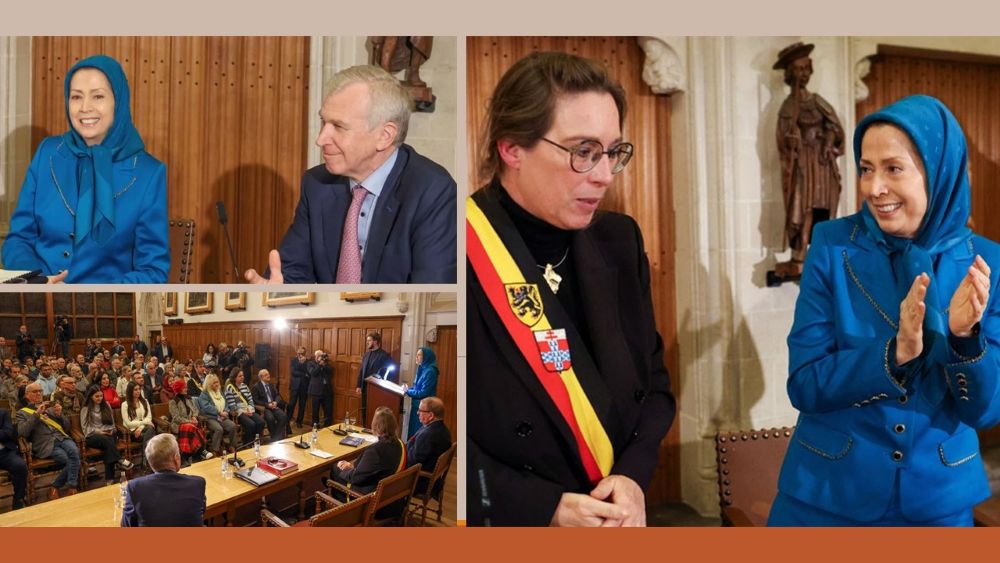
Two days after Human Rights Day, the historic Belgian city of Ypres—known as Europe’s “City of Peace” and marked by its nightly Last Post ceremony—hosted an event at City Hall focusing on Iran’s political crisis. Speakers presented Iran’s situation as both a national tragedy and an international test of commitment to human rights, pointing to executions, repression of dissidents, and systematic pressure on women and youth.
At the center of the visit was Mrs. Maryam Rajavi, President-elect of the National Council of Resistance of Iran (NCRI), who presented the Iranian Resistance’s vision for a democratic republic based on the Ten-Point Plan, including a secular state, gender equality, abolition of the death penalty, and a non-nuclear Iran.
Maryam Rajavi: Linking Ypres’ Memory to Iran’s Struggle
In her address, Mrs. Rajavi connected Ypres’ history of war and remembrance to Iran’s ongoing struggle for freedom. She described Ypres as “a city whose history still speaks to the world,” calling its nightly ceremony “a moral reminder of the cost of war and the value of peace,” and stated, “The world will never forget the sacrifices Ypres made.”
Turning to Iran, she recalled the 1988 massacre , stating that “30,000 political prisoners were massacred,” “hanged across Iran,” and buried in “mass graves,” while families seeking truth and justice continue to be “persecuted.”
Mrs. Rajavi emphasized that “human dignity… lies at the heart of our historic Resistance” and described decades of struggle against a regime she said is “deeply against humanity and peace.” She outlined clear political positions: “No to compulsory Hijab, no to compulsory religion, and no to compulsory governance.” She reiterated the Resistance’s alternative as a republic based on “the separation of religion and state, gender equality, and the abolition of the death penalty,” and stressed the goal of “a non-nuclear Iran” living in peace. She also highlighted the role of Iran’s youth and the organized network of PMOI Resistance Units active inside the country.
Speech at the City Hall of the historic city of Ypres in Belgium
In the European Parliament, and now here, I repeat: The freedom of Iran is a need for the whole world.
In this City of peace, we call on everyone to recognize the Iranian people’s struggle to end the regime and the… pic.twitter.com/vRoJvb5gzu— Maryam Rajavi (@Maryam_Rajavi) December 12, 2025
Katrien Desomer: Ypres as a City of Peace and Responsibility
Ypres Mayor Katrien Desomer said the city’s identity as a “city of peace” is rooted in active responsibility rather than symbolism. Speaking “the day after International Human Rights Day,” she stated that “peace can never be taken for granted” and that democratic societies must “actively safeguard the values” that make coexistence possible.
Referring to the Menin Gate tradition, she called the Last Post “a living symbol,” “a ritual” that “every evening emphasizes the responsibility to continue striving for dialogue, justice, and respect between peoples.” She welcomed Mrs. Rajavi as someone who “plays an important role for the Iranian future and internationally in the fight for human rights, democratic values and social dignity,” adding that Ypres seeks to ensure that “voices that stand up for human dignity continue to be heard.”
Yves Leterme: Democracy, Urgency, and Solidarity
Former Belgian Prime Minister Yves Leterme described Ypres City Hall as a symbol of legitimate governance, recalling that he spent “hours and hours to exercise democracy, to legitimate decision-making for this city,” which he called “only a small example of the practice of democracy.”
He spoke of meeting Mrs. Rajavi near Paris and said he was impressed by her “authentic, moving, description” of conditions in Iran and by “the courage that you kind of symbolize.” Leterme emphasized the breadth of opposition inside Iran, stating that despite the “extreme atrocity of the current regime,” it is “not one, not two, but thousands, hundred thousands” who “want to fight back” and “want to conquer the right to exist, the right to express themselves, to live in freedom.”
Warning against delay, he said, “every hour, every day, every week we have to wait for a change in Iran is too much, too much of suffering,” citing ongoing “executions” and persecution of supporters of the Resistance. He concluded by linking Ypres’ peace message to Iran, repeating, “no more war, no more war,” and stating, “we have to continue to fight for peace… not the least in your nation in Iran.”
“Today, people are fighting to restore democracy in Iran, and we are paying tribute to their resistance and the NCRI, and supporting the objectives of this resistance,” @YLeterme told Simay Azadi’s @Ehsaneghbale on the sidelines of a conference in the historic city of Ypres on… pic.twitter.com/9SUxs2XNVX
— SIMAY AZADI TV (@en_simayazadi) December 13, 2025
Struan Stevenson: Rejecting Dictatorship in All Forms
Former UK MEP Struan Stevenson said Iran’s future should not be framed as a choice between the current clerical regime and a restored monarchy. Referring to his book Countdown to Collapse: Iran’s Regime on the Brink, he said it documents both Iran’s current crisis and the long-standing resistance to dictatorship.
Stevenson criticized the Shah-era government, calling it “the evil regime of the Shah,” and described Reza Pahlavi’s ambitions as “ludicrous,” saying he “wishes to take control of the Peacock Throne and become the king, the emperor of Iran once more.” He cited past corruption and repression, including “the billions that his father stole” and the actions of “SAVAK,” to argue against any return to autocracy.
Invoking Ypres’ World War I history, he linked its legacy to Iran’s victims, citing “120,000 men, women, and children,” including “children as young as the 13-year-old Fatemeh Mesbah,” who he said were killed for supporting the democratic opposition. “Their crime was not violence or treason. Their crime was hope,” he said. He also praised “the bravery of the Resistance Units” who “challenge the forces of darkness and repression in Iran every night and every day,” warning that atrocities continue when the world “looks away.”
Simay Azadi’s reporter @BorjkhaniP1847 brings you a field report from the “In Flanders Fields” Museum in Ypres, Belgium—a place that bears witness to the cost of war and honors those who sacrificed their lives for peace and freedom during World War I. #FreeIran2025 pic.twitter.com/omPmYr1e7H
— SIMAY AZADI TV (@en_simayazadi) December 14, 2025