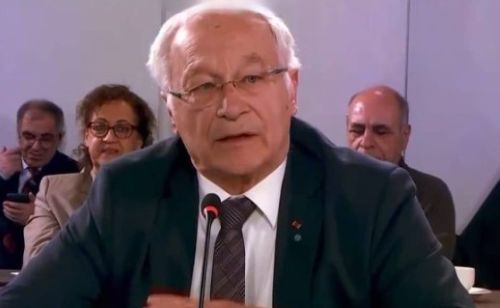

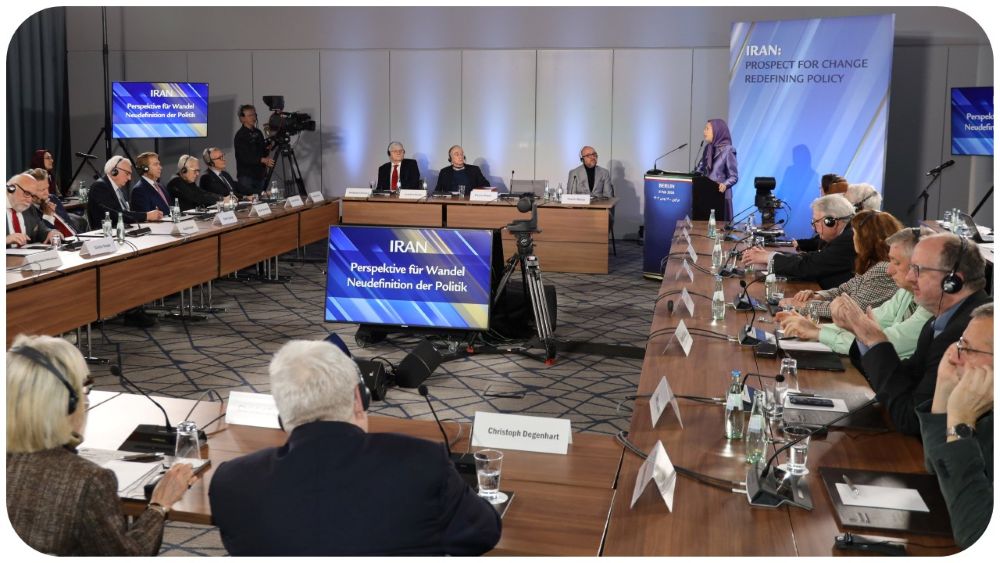
A major international conference held in Berlin on February 8, 2026, brought together senior policymakers, former U.S. and European officials, diplomats, and legal experts to assess Iran’s evolving political crisis and the implications of the nationwide uprising of late December 2025 and January 2026. The gathering, coinciding with the anniversary of Iran’s 1979 revolution, focused on the prospects for democratic change and the role of organized resistance in shaping the country’s future.
Participants described the protests—spanning all 31 provinces—as a decisive turning point in Iran’s political trajectory. They argued that the regime’s violent crackdown, which reportedly resulted in thousands of deaths, has eroded its legitimacy and intensified calls for international accountability. Speakers repeatedly emphasized that a democratic alternative, centered on the Ten-Point Plan of the National Council of Resistance of Iran (NCRI), is positioned to guide a transition toward a secular republic.
Maryam Rajavi: The Inevitability of Democratic Change
Mrs. Maryam Rajavi, President-elect of the National Council of Resistance of Iran (NCRI), opened the session with a resolute address that framed the current crisis not as a moment of chaos, but as the “end of the beginning” for the clerical dictatorship. Paying tribute to the late Professor Rita Süssmuth, a steadfast defender of the Iranian Resistance, Mrs. Rajavi situated the recent events within a broader historical context. She argued that the January uprising has fundamentally altered the political equation in Iran, answering the critical questions of whether change is inevitable, how it can be achieved, and how stability can be maintained post-overthrow.
Mrs. Rajavi emphasized that the uprising was neither spontaneous nor leaderless. She pointed to the organized nature of the protests, noting that “from the very first hours, chants were directed against the religious dictatorship, and the people openly demanded the overthrow of Khamenei.” She highlighted a distinct evolution in the resistance: “The January uprising differed from previous protests in two crucial ways: First, it was significantly organized. Second, rebellious youth confronted the Revolutionary Guards in defense of the protesters, and in several instances succeeded in disarming them.”
Iran Conference: Prospect for change
Featuring Distinguished Figures and Members of the Federal Parliament of Germany
The January uprising answered the question of how change in Iran can be achieved because it demonstrated that, even under relentless and brutal repression, it is… pic.twitter.com/ionyDDtvUu— Maryam Rajavi (@Maryam_Rajavi) February 8, 2026
Addressing the regime’s brutality, Mrs. Rajavi noted that the mass killings—shooting unarmed civilians, executing the wounded, and storming hospitals—were acts of desperation by a system that has “lost the capacity to govern and can sustain itself only through mass slaughter.” She dismantled the notion of reform, citing the regime’s own president, whose policies of sharp fuel price increases and currency devaluation inflamed public anger, proving that “Ali Khamenei is incapable of preserving the system of clerical rule.”
Crucially, Mrs. Rajavi warned against false alternatives that seek to return Iran to the past. She firmly rejected the promotion of the deposed monarchy, stating that “promoting a return to the past serves the regime.” She argued that the Shah’s son not only refuses to distance himself from the one-party dictatorship of his father but proposes a model that would reconstruct autocracy. Instead, she presented the NCRI not just as an opposition group, but as a stabilizing force capable of preventing chaos. “The Resistance movement will not be starting from scratch on ‘day one’ after the regime’s fall,” she assured, outlining a plan for a provisional government to hold elections for a Constituent Assembly within six months.
Mrs. Rajavi concluded with specific demands for the international community, calling for the recognition of the struggle of the rebellious youth, the immediate activation of the “trigger mechanism” of UN sanctions, and the prosecution of regime leaders.
“The January uprising answered the question of how change in Iran can be achieved because it demonstrated that, even under relentless and brutal repression, it is possible for a mass uprising to emerge in conjunction with an organized force.”
“Once this regime falls, a free and democratic Iran can elevate fair political and economic relations to their fullest potential and become a pillar of peace and stability in the region.”
Speech at the Grand Gathering of Iranians in Berlin On the Anniversary of the Iranian People’s Anti-Monarchical Revolution-
Today, no one in the world doubts the certainty of the clerical regime’s overthrow. For years and years, we said: overthrow, overthrow. And now, everyone… pic.twitter.com/hbYeTaiEG2— Maryam Rajavi (@Maryam_Rajavi) February 11, 2026
Joachim Rücker: International Consensus and the Mechanics of Transition
Ambassador Joachim Rücker, former President of the UN Human Rights Council and Special Representative of the UN Secretary-General, delivered a poignant assessment of the regime’s standing. He declared that there is now a “broad, almost complete consensus in the international community that the regime is factually at an end.” He noted that the regime’s proxies in the region have been decimated and that internally, the mullahs can only maintain power through “unfathomable violence.”
Rücker focused heavily on the mechanics of transition and the necessity of inclusivity. He praised the diversity of the Iranian nation, emphasizing that Kurds, Baluchis, Arabs, and other minorities are “an indispensable part of the critical mass for a regime change.” He urged the Resistance to continue linking arms across these diverse groups.
Addressing the vacuum of leadership often feared by Western powers, Rücker dismissed the son of the Shah, citing a Harvard observer who classified Reza Pahlavi’s platform as a “roadmap to neo-fascist rule.” Instead, he endorsed the NCRI’s platform. “I believe that the Ten-Point Plan of the NCRI for an organized transition to a democratic, constitutional, and secular Republic of Iran… represents an excellent platform. I know of no better one on the market,” he stated.
Rücker called for a departure from the “dialogue à la carte” often practiced by European governments. He demanded that Germany and the EU condition any relations with Tehran on the abolition of the death penalty and the release of political prisoners. Furthermore, he advocated for the use of universal jurisdiction to prosecute regime crimes and supported the indictment of Ali Khamenei for his involvement in the war against Ukraine.
“We should orient ourselves toward international law… and clearly state that a regime change can and must only come from the Iranian people and should not be the result of an external military intervention,” he said.


Charles Michel: Lessons from Failed European Policy
Charles Michel, the former President of the European Council and former Prime Minister of Belgium, offered a high-level strategic view of the failure of European policy toward Iran. He began by acknowledging the timeliness of the gathering, noting that the regime is “weaker than ever” due to the degradation of its regional proxies, Hamas and Hezbollah, and its absolute economic failure. “It is not acceptable that one of the richest countries in the world is absolutely incapable of meeting the basic needs of the population,” Michel asserted.
Michel drew a sharp parallel between the Iranian regime and Vladimir Putin’s Russia, describing both as imperialist entities that deny the sovereignty of neighbors and use nuclear blackmail. He categorized the regime’s tactics into three pillars: oppression of their own people, regional destabilization via terrorism, and global intimidation through hostage-taking and cyberattacks. He credited the Iranian Resistance for exposing the regime’s nuclear weapons program, calling it a “game-changer” for global security.
In a candid reflection on Western policy, Michel outlined three critical lessons. First, silence does not work; the regime will not spontaneously reform. Second, appeasement is a failure. “Appeasement only fuels an impression of immunity for the aggressor,” he said, noting that the JCPOA did not yield stability or human rights improvements. Third, while foreign military intervention is not the solution, “neutrality” is no longer an option.
Michel strongly warned European leaders against being “trapped” by the illusion of the Shah’s son as an alternative, describing it as an attempt to “manipulate and steal the future of the Iranian people once again.” He championed the Ten-Point Plan as the “best recipe to move from tyranny to democracy,” praising its commitment to secularism, gender equality, and judicial independence.


Robert Joseph: A Revolution Driven by the Iranian People
Ambassador Robert Joseph, former US Under Secretary of State for Arms Control and International Security, delivered a powerful speech characterizing the current situation in Iran as “the end of the ending for the religious dictatorship.” Drawing on his study of history, Joseph pointed to the participation of the “merchant class and the bazaar” in the January uprising as a terminal indicator for the regime. “If you lose the bazaar, you lose your power,” he observed.
Joseph argued that the revolution is already underway, driven by a population willing to pay the ultimate price for freedom. He dismantled the argument for “reform,” stating that torture and execution are “the very DNA of this regime.” He was emphatic that the solution lies in a revolution “of, and by, the Iranian people,” led by organized resistance, rather than external imposition.
“This is a revolution of, and by, the Iranian people. It is led by the people and the organized resistance on the ground,” he said.
Joseph offered a scathing critique of the monarchy, asserting, “This is not about re-establishing a corrupt and discredited monarchy… Iran has been a nation for over 5,000 years. The people are ready to end this nightmarish chapter.” He called for severe economic sanctions, a total cutoff of oil and financial lifelines, and the closing of regime embassies in Europe.
On the sidelines of the “Iran Conference: Prospect for Change” Ambassador Robert Joseph told Simay Azadi in a part of an exclusive interview that the Iranian people reject any return to dictatorship—whether religious fascism or monarchy—and reaffirmed their demand for a… pic.twitter.com/ldilRtdxx3
— SIMAY AZADI TV (@en_simayazadi) February 9, 2026
Lincoln Bloomfield: Tehran’s Information War and the Role of the Resistance
In a meticulously detailed address, Ambassador Lincoln Bloomfield, former US Assistant Secretary of State for Political-Military Affairs, exposed the “information war” Tehran has waged against the West. He argued that Western policymakers have been seduced by false narratives to preserve nuclear negotiations, concealing the regime’s darkest secrets, including the 1988 massacre of 30,000 political prisoners.
Bloomfield systematically dismantled the allegations against the PMOI/MEK, describing them as a result of the regime’s propaganda. He clarified historical inaccuracies regarding the group’s past, asserting that the MEK has stood for self-government and secularism for 60 years. He highlighted that the regime fears the NCRI and MEK above all else because they represent a direct ideological challenge to the concept of Velayat-e Faqih (absolute clerical rule). “Mr. Rajavi preached to thousands of followers that Islam means freedom and is fully consistent with political rights… including gender equality,” Bloomfield explained.
He also shed light on the regime’s external terror operations, specifically naming Section 312 of Iran’s Ministry of Intelligence, whose sole mission is to threaten and blackmail exiled Iranians. He linked the regime’s survival strategy to the demonization of the resistance, noting that if the full truth of the regime’s atrocities and the resistance’s legitimacy were known, “no government would offer to negotiate a nuclear deal.”
“For 47 years, the clerical regime has feared nothing so much as the NCRI and MEK,” Bloomfield said. “They’ve committed mass murder repeatedly against this one group.”
Bloomfield ridiculed the notion of succession by either Mojtaba Khamenei or Reza Pahlavi, describing them as “two men of no personal distinction or accomplishment, each enriched by the stolen wealth of the nation.” He concluded that the NCRI’s message has successfully permeated Iran despite censorship, mobilizing the very protests the regime fears.


Andreas Reinicke: The Need for a Clear Alternative
Ambassador Andreas Reinicke, former German Ambassador to Syria and Tunisia, brought a comparative diplomatic perspective to the conference. He reinforced the consensus that the regime is at its end but posed the critical question: “How do we actually move forward from here?” He argued that a regime claiming a “divine basis” is inherently unreformable, as it believes it is always right by divine decree.
“A government or a regime that claims a divine basis is actually not reformable. Because those on a divine basis are [always] right,” he said.
Reinicke drew parallels with Syria, noting that while Assad initially had some popularity, he fell because he was incapable of reform. He warned against the “Syrian problem” of having too many fragmented opposition groups, which can paralyze a transition. In this context, he praised the NCRI’s Ten-Point Plan as a vital “signal and symbol” that an organized alternative exists.
“It is extremely important that it becomes clear relatively quickly that there is an alternative that will be shared by many,” Reinicke said. “You are showing that you can also represent an alternative.”

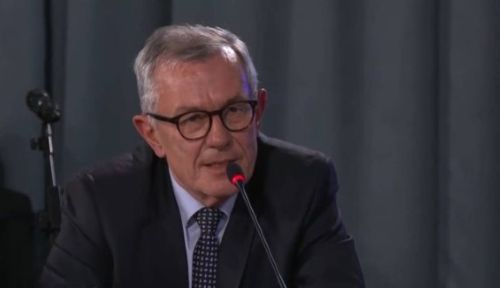
Joachim Bitterlich: No Time to Lose on Iran
Joachim Bitterlich, former advisor to Chancellor Helmut Kohl, offered a candid critique of past European diplomacy. “We Europeans—including we Germans—have made many mistakes regarding Iran over the last 40 years,” he admitted. He expressed deep unease regarding American negotiations, fearing they might be falling into a stalling game designed by Tehran to buy time for a nuclear breakout.
Bitterlich warned that if Iran acquires a nuclear weapon, it will become “untouchable, much like North Korea,” making regime change significantly harder. He argued that there is “no more time to lose.” While opposing a full-scale military solution that could damage the prospects of democracy, he strongly advocated for the NCRI’s Ten-Point Plan.
However, Bitterlich noted that while specialists know about the Ten-Point Plan, the European public needs to be more aware that “another Iran is possible.”
“We have no more time to lose in bringing about a regime change,” Bitterlich said.
Rudolf Adam: Lessons from the Collapse of Dictatorships
Dr. Rudolf Adam, former Vice President of the German Federal Intelligence Service (BND), provided an intelligence perspective on the collapse of dictatorships. He quoted John F. Kennedy, warning that the regime’s prevention of peaceful revolution makes violent revolution inevitable. He criticized the EU’s designation of the IRGC as a terrorist organization as merely symbolic unless followed by “visible and tangible actions.”
Adam shared four historical insights. First, “Unity is strength.” He warned that a divided opposition aids the regime and rejected any return to a “nostalgically glorified past” or dynastic rule. Second, while outside help is needed, democracy cannot be forced with “soldiers’ boots,” as this creates a legitimacy deficit. Third, regimes fall when the “selfishness of their supporters becomes stronger than their loyalty.”
Finally, Adam emphasized that a new government must show visible success quickly to stabilize the country. He endorsed the Ten-Point Plan as the only credible program to escape the “vicious circle of SAVAK and IRGC,” referring to the secret police force of the Shah and brutal armed wing of the Mullahs.
“The future of Iran cannot lie in returning to a nostalgically glorified past. No one may claim special powers based on their dynastic origin,” Adam said regarding the illusion being publicized by the remnants of the shah regime that Iran wants to return to the dictatorship of Pahlavi.
Günter Nooke: A Call for Accountability and Policy Change
Günter Nooke, former Human Rights Commissioner for the German government, delivered a scathing critique of German foreign policy, particularly citing the era of Frank-Walter Steinmeier and the 2015 nuclear deal.
“I believe the [nuclear deal] is something we cannot be proud of, but rather something for which we should apologize,” Nooke said.
He stated that German politicians should “apologize” for courting the Iranian leadership at forums like the Munich Security Conference. His core message was simple: “When in doubt, it is always better to maintain the greatest possible distance from dictatorships.”
Nooke warned that any new deal struck by the US or Europe with Tehran would only stabilize the regime “just before its end.” He focused on the issue of impunity, noting that the lack of accountability for crimes against humanity encouraged the mass murder of protesters in 2022 and 2026.
Drawing on his experience with the East German dictatorship, Nooke proposed a concrete policy action: the establishment of an “International Human Rights Observatory” modeled after West Germany’s “Salzgitter” center, which tracked human rights abuses in the GDR. He argued that formally registering evidence of torture and murder in a legally sound manner would signal to regime perpetrators that they will eventually be held accountable, thereby potentially fracturing their loyalty to the leadership.
“We, the West, must ally ourselves with those who propose a democratic alternative and fight for it… we must stand in solidarity with those who… are even prepared to die for it,” Nooke said.
Christoph Degenhart: Law, Media, and the Battle Against Disinformation
Professor Christoph Degenhart, a renowned German constitutional law expert, focused on the intersection of law, media, and politics. He highlighted the regime’s dual strategy of brutal violence and “subtle means of disinformation.” He accused the regime of buying journalists to produce reports in mainstream German media that demonize the PMOI/MEK.
Degenhart celebrated the NCRI’s legal victories in courts, which have consistently overturned terrorist designations, proving that “the rule of law functions to some extent.” He urged the Resistance to be even more active in countering disinformation, specifically citing recent attempts by German newspapers to portray the Shah’s son as a serious alternative—a narrative he dismissed as a result of falling for regime propaganda.
“The NCRI has certainly achieved successes for the PMOI in the courts,” Degenhart said. “It is our task, and your task, to become even more active in providing information and to counter this disinformation.”
Looking to the future, Degenhart stressed the importance of a constitutional transition. He noted that unlike post-war Germany, where many supported the Nazi regime until the end, 90% of Iranians oppose the mullahs, creating a unique opportunity. He called on the West to recognize its “debt” to the Iranian people for having tolerated the regime for so long.
“Admiration for the courage of the Iranian people must go hand in hand with a decisive change in policy,” he said. “Negotiations with a partner like Iran will ultimately prove to be counterproductive.”
Martin Patzelt: Grassroots Momentum and Democratic Solidarity
Martin Patzelt, a former member of the German Bundestag and part of the German Solidarity Committee for a Free Iran, spoke with emotional resonance about the grassroots support for the Iranian cause. He described the recent rally in Berlin as a “paradigm shift,” noting the massive turnout despite freezing weather as a testament to the hope the Resistance inspires.
“We hope with all our hearts—and that is why yesterday was a wonderful event—that we reach a paradigm shift,” he said.
Patzelt reflected on the difficulty of fighting against the policy of appeasement within the German political establishment, admitting that he and his colleagues were often “voices in the wilderness.” However, he expressed optimism that the sheer scale of the uprising and the organization of the Resistance are finally forcing a change in perspective among German MPs.
He emphasized the “obligation to deliver,” framing the support for Iranian democracy as a test of Western democratic values. Patzelt called for practical measures, specifically “turning off the money tap” and denying visas to IRGC members. He concluded by praising the unity of diverse Iranian ethnic groups—Kurds, Baluchis, and others—visible at the rally, seeing it as a preview of a future democratic Iran.