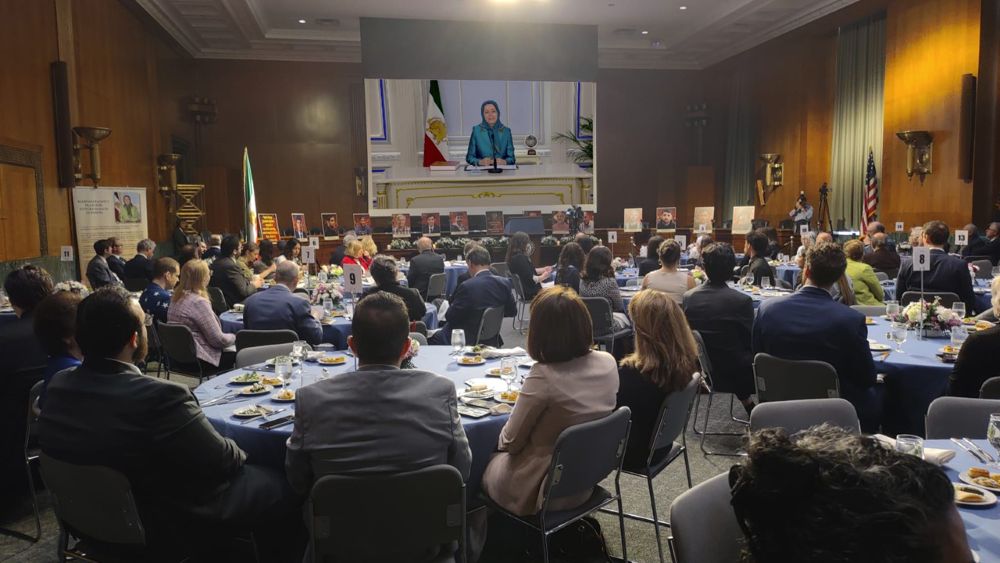
WASHINGTON, D.C., April 16, 2026 — A bipartisan group of U.S. Senators and former senior diplomats convened a high-level briefing titled “Iran: Towards Peace and Freedom,” presenting a unified stance that neither military intervention nor continued appeasement can resolve the ongoing crisis in Iran. The participants called for recognition of the Iranian people’s right to overthrow the current theocratic system and identified the National Council of Resistance of Iran (NCRI) as a democratic alternative to both the ruling establishment and the former monarchy.
The event was held against a backdrop displaying portraits of recently executed members of the People’s Mojahedin Organization of Iran (PMOI/MEK) and other protesters.
Thank you to all who attended our U.S. Senate Briefing today.
Iran’s future should NOT be decided by recycled claims of destiny or nostalgia.
The future of Iran should be decided by the people and the organized resistance! pic.twitter.com/r23b8I6dFA
— OIAC: Organization of Iranian American Communities (@OrgIAC) April 16, 2026
Maryam Rajavi
In her keynote address, Mrs. Maryam Rajavi, President-elect of the NCRI, stated that “the solution to the crisis in Iran lies in its people, in their courage, and in their organized resistance.” She said that after 47 years of policies including appeasement, negotiations, and war, the international community must recognize that the current regime “will neither revise its policy of repression nor abandon its efforts to obtain a nuclear weapon.”
Mrs. Rajavi emphasized that a key shortcoming in Western policy has been the “failure to recognize the role of the Iranian people and their organized resistance in bringing about change.” She urged lawmakers worldwide to support the “Resistance Units that stand on the front lines of the struggle for freedom” inside the country.
US Senate Briefing, “Iran: Onward to peace and freedom”
Today, more than ever, a fundamental question is before us: What is the real solution to Iran’s crisis?
The solution to the crisis in Iran lies in its people, and in their organized resistance.#FreeIran10PointPlan pic.twitter.com/0SVcFr7xmv— Maryam Rajavi (@Maryam_Rajavi) April 16, 2026
Rejecting any return to monarchy, she stated: “I must emphasize that the people of Iran do not want to return to the dictatorship of the Shah.” She challenged the ruling system to demonstrate its claimed public support by accepting “a free election under United Nations supervision and based on the principle of popular sovereignty, not clerical rule.”
Mrs. Rajavi presented the NCRI’s “Ten-Point Plan” as a roadmap for a post-theocratic Iran, outlining a vision that includes “free elections, gender equality with participation of women in political leadership, the separation of religion and state, recognition of the rights of oppressed ethnic groups, a non-nuclear policy, and peaceful coexistence.” She added that the NCRI aims to hold free elections within six months after the fall of the regime to “hand over the power to the elected representatives of the people.”
🔶🎥 Full video of the address by NCRI President-elect Maryam Rajavi, delivered at a U.S. Senate briefing on Iran, where bipartisan senators also spoke on April 16, 2026. The briefing was covered live by @livenowfox .#NCRIAlternative #FreeIran10PointPlan pic.twitter.com/88sz2dVO9z
— NCRI-U.S. Rep Office (@NCRIUS) April 17, 2026
Marc Ginsberg
Marc Ginsberg, former U.S. Ambassador to Morocco, opened the briefing and affirmed his “unyielding commitment for decades to a free democratic Iran,” noting that this commitment is rooted in personal losses his family experienced due to Iranian state-sponsored terror.
Serving as moderator, he stated that the Iranian people “are not interested in a monarchy” and have no desire for a “pretender to the throne who has sat in Los Angeles sunning himself” while others have sacrificed.
Amb. Ginsberg highlighted the strength of the “internal compatriots of the MEK” and described Maryam Rajavi as the “future Iron Lady of Iran.” He said her “Ten-Point Plan” reflects principles such as separation of religion and state and gender equality, comparing them to a modern Declaration of Independence.
He called for a “new Iran Freedom Act” to replace efforts aimed at a “grand bargain” with the ruling system and urged formal “recognition of a provisional government” along with “communications and intelligence support” for opposition forces. He concluded that the regime’s actions show it “fears its own people more than it fears an external enemy.”
Senator Thom Tillis
Senator Thom Tillis, co-chair of the bipartisan Senate Human Rights Caucus, delivered remarks emphasizing the need for a long-term and legally binding U.S. commitment to Iranian freedom. Referring to the displayed portraits, he said, “someday I hope we’re doing this in Tehran.”
He stated that the current geopolitical moment provides an opportunity to achieve “real meaningful and lasting change” rather than merely containing the regime. While acknowledging the need to address the “threat of nuclear weapons that the mullahs represent,” he stressed the importance of placing Iran on a “path to freedom.”
Senator Tillis called for any future agreement to be “ratified by Congress so that it transcends administrations,” adding that such an approach would help replace what he described as “theo-fascist” rule with a system based on popular sovereignty.
Senator Cory Booker
Senator Cory Booker spoke about the sacrifices made by those who have given their “last full measure” for the cause of freedom, noting that the issue holds personal significance for his family.
He rejected the idea that self-determination is a Western concept, stating, “All people deserve liberty, all people deserve justice,” and emphasized that these are universal human rights.
Senator Booker highlighted the need for political engagement in Washington to match expressions of solidarity, praising what he described as the “quiet patriotism” of individuals working for freedom in both Iran and the United States. He concluded by stating, “The people of Iran will be free.”
Senator @CoryBooker spoke at our U.S. Senate Briefing.
Senator Booker is right. This isn’t a partisan issue…. It’s a right vs. wrong issue.
The Iranian people have been fighting this tyrannical regime for decades, and it’s time we put our full support behind them!#FreeIran… pic.twitter.com/0hObPYJ633
— OIAC: Organization of Iranian American Communities (@OrgIAC) April 16, 2026
Former Senator Roy Blunt
Former Senator Roy Blunt emphasized the consistency and preparedness of the Iranian Resistance, noting that the “Ten-Point Plan” has served as a roadmap for “two decades.”
He stated that this continuity demonstrates that the NCRI is prepared to lead a transition rather than acting as a reactionary force. Criticizing international diplomacy, he said, “there should be no guarantees in any agreement with the regime that we in any way will stand by and affirm the regime.”
Blunt stressed that global policy should prioritize efforts to “stop the executions now” and end violence against protesters. He also referenced the NCRI’s proposed interim government structure aimed at ensuring stability while moving toward “democratic free and fair elections.”
Senator @RoyBlunt spoke at our U.S. Senate Briefing.
Senator Blunt honored those who have been mercilessly executed by this regime, while also pointing attention to @Maryam_Rajavi’s 10 point plan, which lays the transition framework that allows Iran to hold a free and democratic… pic.twitter.com/bpnTr3IO1O
— OIAC: Organization of Iranian American Communities (@OrgIAC) April 16, 2026
Carla Sands
Carla Sands, former U.S. Ambassador to Denmark, stated that “The Iranian crisis cannot be solved from outside. It must be resolved from within. This is not an abstract conclusion, it’s a strategic fact.”
I’m proud to stand alongside Ambassador @SamuelBrownback with the patriotic resistance of Iran and mourn the loss of young Iranians like champion wrestler Saleh Mohammadi. @iran_policy @NCRIUS pic.twitter.com/TWkxeKsgtj
— Carla Sands (@CarlaHSands) April 16, 2026
She said that neither appeasement nor military intervention offers a solution, adding that while force may weaken the system, it cannot establish democratic legitimacy. She described the current government as being at its weakest point since 1979 but increasingly repressive because “it fears its own population more than any foreign bombs.”
Ambassador Sands highlighted the role of Iranian women as the “core” of the organized resistance and rejected any return to monarchy, stating that “Iran’s future will not be shaped by relics of the past.” She called for U.S. recognition of the NCRI and its provisional government and described Mrs. Rajavi’s platform as a path toward a secular, democratic, and non-nuclear republic. She also called for an end to what she described as “decades of misinformation and marginalization.”
Ambassador Sam Brownback
Ambassador Sam Brownback, former Governor and Senator from Kansas, framed the current situation as part of a five-decade struggle. Using a sports metaphor, he said, “We are in the red zone now… We are close to winning. We can win this. This is the time.”
He described the current situation as “extremely, extremely dangerous” and said the system must be removed rather than managed. Ambassador Brownback expressed strong support for the NCRI, stating that it has maintained pressure on the Iranian government for 50 years.
He emphasized the role of the MEK as a force with “boots on the ground” and urged the United States to “seize this moment that has been pushed for and sought after and desired for 50 years,” warning that inaction would lead to more severe global consequences.
Honored to be with @CarlaHSands at a Free Iran event today. A picture of the executed Iranian wrestler Saleh Mohammadi is in the background. He was a patriot and didn't deserve his fate. He deserved a free country. We can do more to help those seeking regime change in Iran. pic.twitter.com/Sk2hacnIJB
— Sam Brownback (@SamuelBrownback) April 16, 2026
Full Video of the U.S. Senate Briefing – Examining U.S Policy Options On Iran In Critical Times: