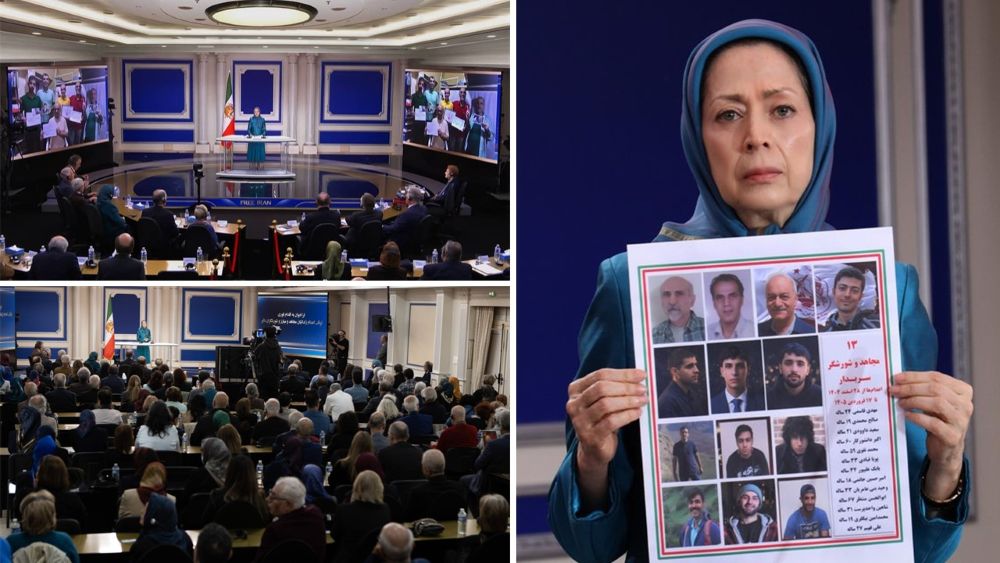
An international conference held near Paris on April 10, 2026, brought together prominent European political and legal figures alongside survivors of Iran’s prison system to condemn the escalating wave of executions in Iran and express support for the National Council of Resistance of Iran (NCRI).
Titled “A Call for Immediate Action to Halt the Executions of PMOI and Dissident Political Prisoners,” the event honored recently executed members of the People’s Mojahedin Organization of Iran (PMOI/MEK) and anti-government protesters. Participants warned that the surge in executions reflects the Iranian regime’s intensifying repression and reaffirmed the NCRI as a viable democratic alternative.
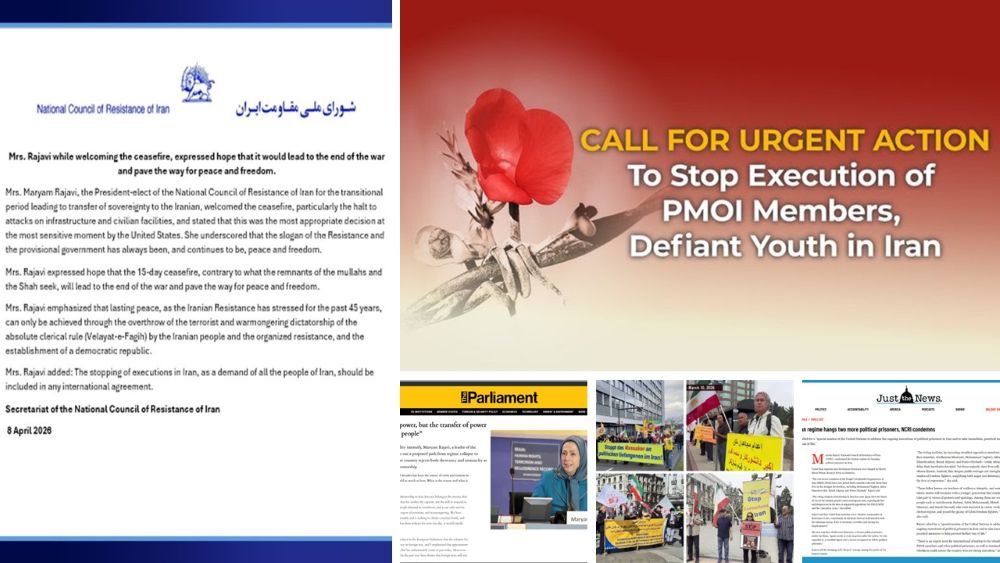
Call for Urgent Action To Stop Execution of PMOI Members, Defiant Youth in Iran#StopExecutionsInIran #Iran https://t.co/oZ3d15zt3O
— Iran Freedom (@4FreedominIran) April 10, 2026
Maryam Rajavi
Mrs. Maryam Rajavi, the President-elect of the NCRI, delivered a poignant keynote address, framing the recent executions of six PMOI members and seven young protesters as a “price paid for Iran’s freedom and independence.” She asserted that by executing these “martyrs of peace” amidst external war, the regime has signaled that its true enemy remains the “organized resistance.” Mrs. Rajavi noted that the “pure blood” of the fallen has “upended the calculations of the regime, the remnants of the monarchy, and the fabricated, anti-democratic alternatives.”
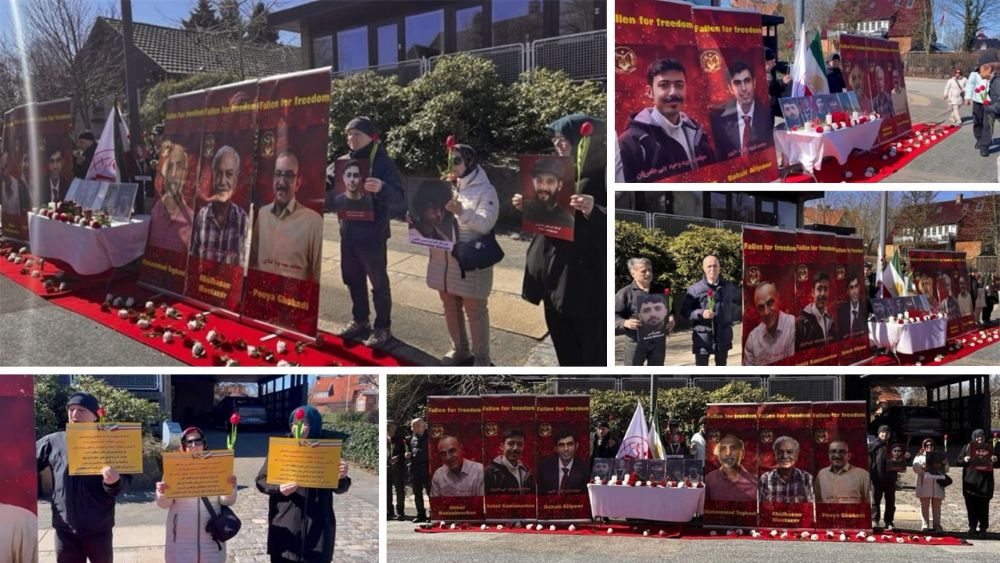
Commemoration of Executed PMOI Members and Protesters
The price of freedom and an enduring peace in Iran and the entire Middle East
By executing PMOI members—Mohammad Taghavi, Akbar Daneshvarkar, Babak Alipour, Pouya Ghobadi, Abolhassan Montazar, and Vahid Bani Amerian—who at the… pic.twitter.com/WWYxUvXjUm— Maryam Rajavi (@Maryam_Rajavi) April 10, 2026
Furthermore, Mrs. Rajavi emphasized that the path to victory lies in the strength of an organized movement rather than external forces or diplomatic maneuvers. She declared that it has become clearer than ever that the solution for Iran is neither “appeasement nor war,” but the “overthrow of the regime by the people and their organized resistance”. She pointed to the “Generation of the Countless” and the expanding network of “Resistance Units” across all provinces—from Tehran to Zahedan—as proof that the nationwide resistance has achieved the capacity to topple the religious tyranny and establish a democratic republic.
Reflecting on the atmosphere of the conference, Mrs. Rajavi remarked, “This workshop was very long… I was shedding tears with every word and sentence of yours and all these images, while being immersed in pride and honor for all this sacrifice.” She emphasized that the regime uses execution to create “intimidation, to suffocate, and to remove [opponents] from the way,” but predicted its ultimate failure, just as the Shah’s “powerful army” could not prevent his flight. She demanded that “ending executions in Iran… must be included in any international agreement” and challenged the regime to accept “free elections for a constituent assembly or the presidency, under United Nations supervision.”
Commemoration of Executed PMOI Members and Protesters
The price paid for freedom and lasting peace in Iran and the Middle EastMembers of the PMOI—Mohammad Taghavi, Akbar Daneshvarkar, Babak Alipour, Pouya Ghobadi, Abolhassan Montazar, and Vahid Bani Amerian—who at the time of… pic.twitter.com/6VbpnMtXz7
— Maryam Rajavi (@Maryam_Rajavi) April 10, 2026
Herta Däubler-Gmelin
Prof. Dr. Herta Däubler-Gmelin, former German Minister of Justice, emphasized the legal and moral obligation of the international community to intervene against the surge of executions. She highlighted that the “courageous protesters” and “dissident political prisoners” are being targeted because they represent the “voice of a society that refuses to be silenced.”
Prof. Dr. Däubler-Gmelin argued that silence in the face of such judicial brutality is not neutrality but complicity. She called for a “clear and firm international stance,” asserting that human rights must not be sidelined for the sake of diplomatic expediency. She specifically noted that the “Ten-Point Plan” proposed by the NCRI offers a “vision for a democratic Iran based on the rule of law,” which stands in stark contrast to the regime’s “arbitrary use of the gallows.”
John Bercow
The Rt Hon John Bercow, former Speaker of the House of Commons, delivered a blistering and extensive critique of both the current theocratic regime and the remnants of the Pahlavi monarchy. He began by asserting that the “idea of freedom cannot be executed,” adding that while the regime uses the gallows to intimidate, “the fact of the perseverance to victory championed by those brave souls will be” the true historical record. He emphasized that he has “absolute confidence” in his heart and head that those who have devoted their lives to the struggle will be recognized as the “only and the legitimate alternative to the bestial dictatorship in Tehran”.
John Bercow, in part of his remarks dismissed the political relevance of Reza Pahlavi, the son of the ousted Shah. He stated, “Mr. Pahlavi… you are one gigantic, monumental, everlasting sideshow. You are irrelevant to the real struggle”. He argued that Pahlavi had “scuttled off to the United States” decades ago and had not performed any “useful work” since. Addressing Pahlavi directly, he remarked, “Mate, you are deluded. In political terms, you are off your chump. You haven’t got a clue. It’s not going to happen”.
Furthermore, Bercow rejected the notion that the Iranian people would ever seek a return to a monarchical system. He questioned how the “mass of the people of Iran” could ever turn to the son of an “appalling autocrat who pillaged the country and presided over mass destruction”. He characterized hope of being “the prince over the water who will come to the rescue” as a “fairy tale” that he personally stopped believing in as a teenager. He concluded that the future of Iran rests solely with the organized resistance that has made the necessary sacrifices for a democratic republic.
Franz Josef Jung
Dr. Franz Josef Jung, former German Federal Minister, voiced strong support for the Ten-Point Plan of Mrs. Maryam Rajavi, describing it as the essential framework for a democratic transition. He stated that the international community has a responsibility to back this vision, which includes “important political demands for free and secret elections, for freedom of speech, for the freedom to form political parties, and for freedom of the press”.
Dr. Jung noted that the bravery of the executed PMOI members serves as a definitive testament to the regime’s failure to break the spirit of the resistance. He asserted that the current climate of repression proves that the regime is incapable of reform, and therefore, the world must recognize the NCRI as the only “credible alternative” to the mullahs’ rule.
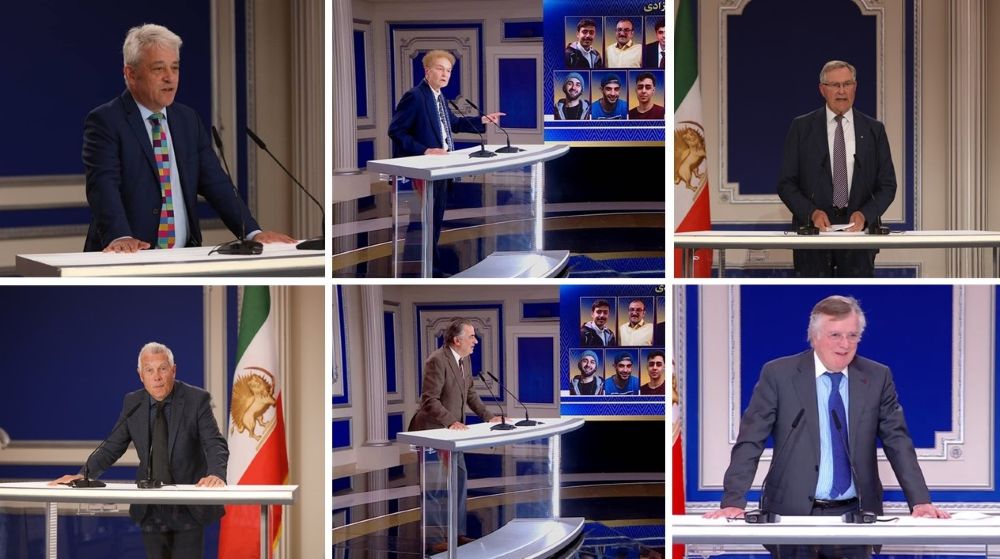
Jean-François Legaret
Jean-François Legaret, head of the Femo Institute and former Mayor of Paris 1st District, warned against the “false news” that diplomatic shifts or foreign strikes alone could end the dictatorship. He noted that while Western leaders might hope for a “diplomatic phase,” discussing terms with a “terrorist state” that should instead be “answering for its crimes, rapes, and permanent violations of human rights” before international tribunals is a grave mistake. He stated firmly, “One does not roll out the red carpet or sit at the negotiating table with a terrorist state”.
Mr. Legaret dismissed the current administration in Tehran as a collection of “puppets,” noting that President Pezeshkian is “devoid of all power” while the IRGC’s grip on the country has “considerably hardened”. Regarding the remnants of the monarchy, he questioned the legitimacy of the Shah’s son, Reza Pahlavi, asking, “What is his experience, what is his legitimacy to embody the future of the Iranian people?”. He concluded that freedom “can only be achieved at the cost of the insurrection of the Iranian people,” describing such an uprising not as a war for destruction, but as a “war for peace, for democracy, and for the future”.
Jean-Pierre Béquet
Jean-Pierre Béquet, former Mayor of Auvers-sur-Oise, emphasized that the recent executions expose the “fragility of this hyper-repressive regime”. He argued that in global geopolitical declarations, “the great forgotten one is the Iranian people,” who are often overlooked while foreign powers claim victory for their own strategic interests. He asserted that the people “can expect nothing” from foreign intervention or regional power plays.
Mr. Béquet stated that democracy will not be delivered “by bombs,” but by the “daily struggle of the Iranian people with the international support of all those who want freedom”. He rejected any transition that would lead to a “dictatorship” under a different name, stating that the path forward is neither “theocracy nor military dictatorship”. Regarding Reza Pahlavi, he was dismissive, stating, “I don’t even want to talk about him… let him return to his fortune in the United States… but above all, let him not look after others”. He concluded by calling for all democrats to unite first to “stop the executions” and then to support the organized uprising of the people.
Jean-Pierre Spitzer
Jean-Pierre Spitzer, a prominent French lawyer, reviewed the 24-year legal history of his involvement with the Resistance, recalling the 2002 blacklisting as an “infamy” perpetrated by governments in London and Paris. He noted the irony that “those who had forced, bought… governments… to treat you as terrorists… are today on the blacklist,” referring to the IRGC. He praised the movement for its discipline, recalling how Mrs. Rajavi told him at their first meeting, “Maître, we choose the law”.
Mr. Spitzer criticized Western leaders for being “fascinated by the charm” of Iranian diplomats, comparing those who excuse the regime’s crimes to people in 1940 who spoke highly of Nazi officials. He addressed the role of the Shah’s son, suggesting that Reza Pahlavi was merely a tool used briefly by foreign interests for credibility: “As today no longer wants to overturn the mullahs, he has thrown out the son of the Shah who returns to what he is, that is to say, nothing”. He closed with a solemn promise: “When I go with you to Tehran, I will take back my robes… I want to plead as a civil party alongside the prosecution against the executioners” to ensure that the martyrs finally receive justice.
Nasrollah Marandi
Nasrollah Marandi, a former political prisoner and survivor of the 1988 “death corridors,” spoke to the continuity of the Resistance. He described the recently executed PMOI members as “students of Massoud Rajavi” who “stood against both the Shah and the mullahs and broke the deadlocks.”
Marandi reflected on the “silence of solitary cells” he experienced in the 1980s, testifying that the “executioners of Khomeini” could not break the spirit of the PMOI members. He linked the current “Resistance Units” to the heroes of the past, stating that the sacrifice of today’s youth in Tehran and Qom proves that the “ideology of egoism” has been defeated by a commitment to “everything for our oppressed people.” He concluded with a vow: “We swear by the blood of our companions, we stand until the end.”
Reza Shemirani
Reza Shemirani, a former political prisoner who spent over 4,000 days in the regime’s jails, highlighted the symbolic evolution of Iran’s prisons. He noted that “Evin and Gohardasht… were built by the Shah and completed by Khomeini,” and pledged they would be “destroyed” by the revolution.
Shemirani addressed the unwavering stance of prisoners who remain steadfast. He challenged the notion that the era of idealism is over, pointing to the “courage of the Resistance Units” as evidence that “the spirit of the 1988 massacre victims lives on.” He reaffirmed his commitment to continue the struggle, stating, “We do not fight for power or share-seeking. What drives us forward is sacrifice for the people and freedom.”
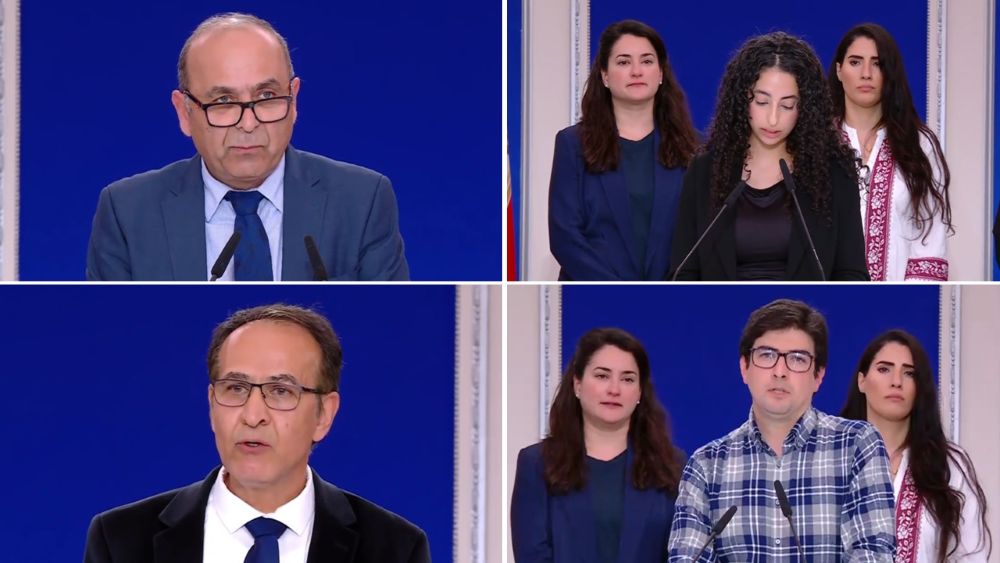
Minoosh Mashhadi
Minoosh Mashhadi, representing the Iranian diaspora in the Netherlands, spoke on the regime’s “war against its own people” that has lasted over 40 years. She noted that while the world sees headlines about external wars, for Iranians, the enemy has never changed.
Mashhadi highlighted the conscious choice of martyrs like Vahid Bani-Amerian, who “could have signed a forced confession… but chose not to.” She called for the closure of the Iranian regime’s embassies in Europe, describing them as “instruments of the regime’s repression” used to track and threaten exiles. She concluded by stating that the Ten-Point Plan is not just a wish, but a “roadmap led by someone who has dedicated her entire life to making it a reality.”
Mohsen Kasechi
Mohsen Kasechi focused on the impact of the Resistance within Iranian society, where “mentioning the word PMOI requires courage” as it is the “reddest line of the regime.” He stated that today’s youth have “mocked death” and brought the regime’s interrogation apparatus “to its knees.”
Kasechi observed that the “Resistance Units” involve “Gen Z and even Millennials,” proving that the spirit of sacrifice is “alive and reproducible.” He argued that the PMOI’s 60-year history has shown that freedom will not be won through “foreign wars or appeasement,” but through “the path of the Resistance”. He concluded by noting that the “fire in the hearts” of this generation makes them “invincible” in the face of the gallows.