



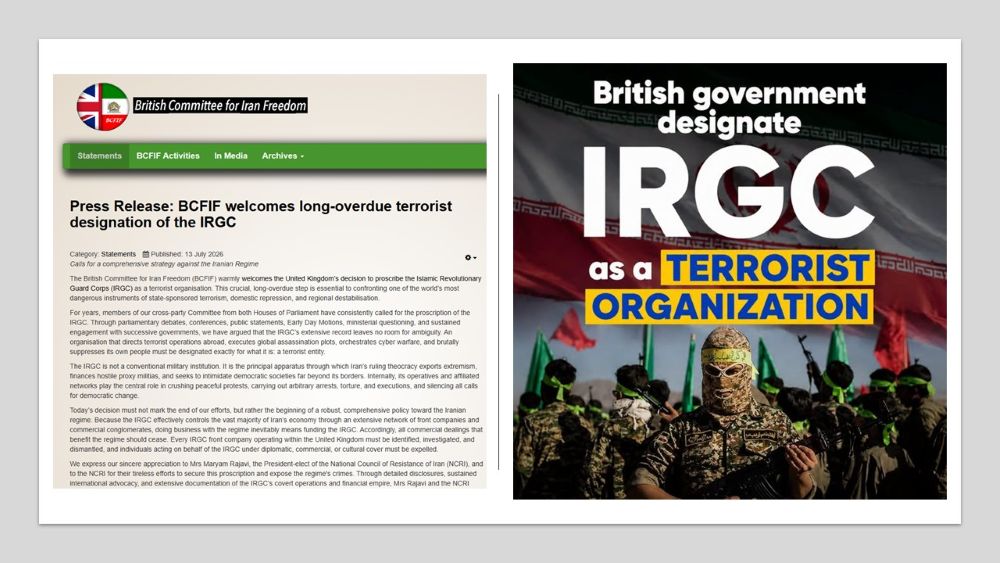
The British Committee for Iran Freedom (BCFIF) has welcomed the United Kingdom’s decision to proscribe the Islamic Revolutionary Guard Corps (IRGC) as a terrorist organisation, describing the move as a “crucial, long-overdue step” in confronting what it called one of the world’s most dangerous instruments of state-sponsored terrorism, domestic repression, and regional destabilisation.
In a statement published on 13 July 2026, the BCFIF said that members of its cross-party committee from both Houses of Parliament had for years called for the IRGC’s designation through parliamentary debates, conferences, public statements, Early Day Motions, ministerial questioning, and continued engagement with successive governments.
The committee stated that the IRGC’s record left “no room for ambiguity,” arguing that an organisation involved in terrorist operations abroad, global assassination plots, cyber warfare, and the suppression of domestic dissent should be designated as a terrorist entity.
According to the BCFIF, the IRGC is not a conventional military institution but the main mechanism through which Iran’s ruling system exports extremism, supports hostile proxy militias, and seeks to intimidate democratic societies beyond its borders. The committee also accused IRGC operatives and affiliated networks of playing a central role in suppressing protests, carrying out arbitrary arrests, torture, executions, and preventing calls for democratic change.
The BCFIF emphasised that the UK government’s decision should represent the beginning rather than the conclusion of a broader policy approach toward the Iranian regime. The committee argued that because the IRGC controls a significant part of Iran’s economy through front companies and commercial networks, business dealings that benefit the regime should end.
The statement called for the identification, investigation, and dismantling of IRGC front companies operating in the United Kingdom. It also urged the removal of individuals acting on behalf of the IRGC under diplomatic, commercial, or cultural cover.
The committee expressed appreciation to Maryam Rajavi, the President-elect of the National Council of Resistance of Iran (NCRI), and the NCRI for what it described as their efforts to secure the proscription and expose the Iranian regime’s actions. The BCFIF said that detailed disclosures, international advocacy, and documentation of the IRGC’s covert operations and financial networks had contributed to informing parliamentarians, governments, and the international community about the organisation.
The BCFIF reaffirmed its support for the people of Iran in their pursuit of freedom, democracy, and the rule of law. The committee said that the Iranian people have repeatedly rejected dictatorship and aspire to a democratic republic based on universal suffrage, human rights, and the separation of religion and state.
The statement concluded by calling on the British government to support the Iranian people’s efforts for freedom and democracy and to recognise what it described as the right of the Iranian people and their resistance movement to confront the IRGC and bring an end to dictatorship, paving the way for a democratic republic.
British Committee for Iran Freedom
13 July 2026