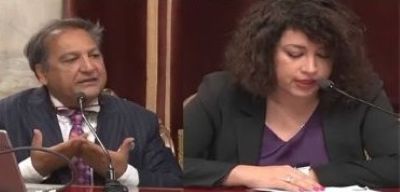


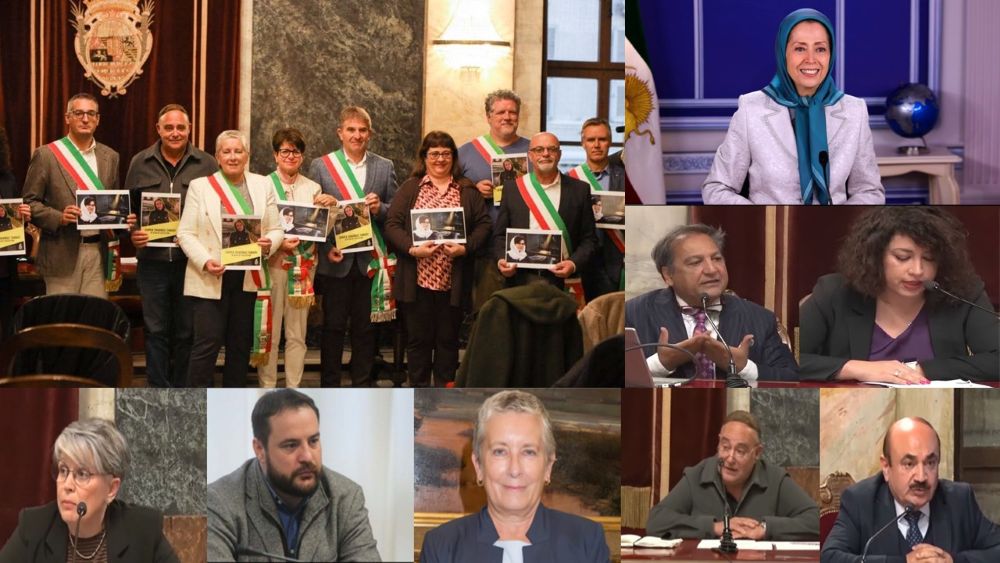
On Friday, October 23, 2026, a conference titled “No to Executions, Yes to Supporting the Iranian Resistance” took place in the Hall of Honors at Cuneo City Hall in Italy. Organized with the support of the Municipality of Cuneo, the Cuneo chapter of the National Association of Italian Partisans (ANPI), and the Association of Iranian Doctors and Pharmacists Residing in Italy, the event brought together local mayors, city councillors, a senator, partisans’ representatives, and members of the Iranian diaspora to denounce the death penalty and repression in Iran while affirming solidarity with the Iranian people’s struggle for freedom, democracy, and self-determination.
Key participants included Patrizia Manassero (Mayor of Cuneo and former Italian Senator), Claudia Carli (Democratic Party group leader on the Cuneo City Council), Former Senator Roberto Rampi, Lanzo Ruggiero (Vice President of the ANPI), Mahmoud Hakamian (member of the NCRI Foreign Affairs Committee), Elham Nikzat (representative of Iranian Democratic Women in northern Italy), and Dr. Khosrow Nikzat (President of the Association of Iranian Doctors and Pharmacists Residing in Italy), along with several other mayors and local officials.
A video message from Mrs. Maryam Rajavi, President-elect of the National Council of Resistance of Iran (NCRI), was also broadcast.
Maryam Rajavi President-elect of the NCRI
In her message to the Cuneo conference, Mrs. Maryam Rajavi stressed that the clerical regime’s heavy reliance on executions reveals its fundamental weakness and instability. She noted that since the war earlier in 2026 the authorities have hanged dozens of political prisoners, including nine PMOI members, and protesters from the January uprising, with many more facing death sentences after unfair trials and torture—citing the case of 25-year-old Arghavan Fallahi, sentenced for supporting the PMOI. Rajavi argued that these atrocities cannot save the regime or crush the resistance; rather, they confirm it stands on the verge of overthrow by the Iranian people and their organized Resistance Units. She thanked Cuneo for its historic solidarity (including the 2008 twinning with Ashraf) and called on Italy and the world to recognize the people’s struggle for a democratic republic while making relations with the regime conditional on ending executions.
Message to the Conference at the City Hall of Cuneo, Italy
If the clerical regime in Iran had any stability, it would not resort to executions.
It is time for Italy and the entire world to recognize the Iranian people's struggle to overthrow the regime, as well as the fight of… pic.twitter.com/vDtV98Ld8L— Maryam Rajavi (@Maryam_Rajavi) October 23, 2026
Claudia Carli
Claudia Carli, Democratic Party group leader on the Cuneo City Council, reaffirmed the city’s longstanding solidarity with the Iranian people, rooted in its identity as the “City of Freedom and Resistance.” She recalled the unanimous council resolutions of 2022 and 2024 condemning repression, violence, executions, and grave human rights violations, describing executions without proper judicial process as tools of fear and crimes against humanity. Carli endorsed the Iranian Resistance’s Ten-Point Plan as the framework for a democratic republic based on popular sovereignty, gender equality, separation of religion and state, abolition of the death penalty, and respect for human rights, urging sustained international attention so that those resisting dictatorship are not abandoned
Senator Roberto Rampi
Former Italian Senator Roberto Rampi warned that the Iranian regime’s survival threatens global peace and prosperity because its ideological foundations make genuine compromise impossible. He highlighted the denial of democratic sovereignty, the political exploitation of religion to suppress dissent, the extensive use of executions (including against those who were minors at the time of alleged offenses), and the diversion of national wealth to regional proxy groups that destabilize the Middle East. Rampi rejected both foreign military intervention and appeasement, instead calling for sustained international pressure centered on human rights and for support of the organized Iranian Resistance and Maryam Rajavi’s Ten-Point Plan for a democratic, secular republic.
Patrizia Manassero
Patrizia Manassero, Mayor of Cuneo and former Italian Senator, reaffirmed the city’s deep solidarity with the Iranian Resistance, recalling Cuneo’s 2008 twinning with Ashraf as a symbol of shared commitment to freedom and democracy against authoritarian rule. She condemned the escalating wave of executions targeting protesters, especially young women and men, and insisted that geopolitical tensions must not distract from this repression. Drawing on Italy’s own history of resistance against fascism, she pledged that Cuneo would continue standing alongside the Iranian people until a democratic future is achieved, emphasizing that distance must never become an excuse for silence.


Lanzo Ruggiero
Lanzo Ruggiero, Vice President of the National Association of Italian Partisans (ANPI), reaffirmed the organization’s longstanding support for the National Council of Resistance of Iran and Maryam Rajavi’s Ten-Point Plan for a democratic republic based on popular sovereignty, pluralism, justice, and separation of religion and state. He condemned the hundreds of executions carried out in Iran in 2026 as an unacceptable instrument of intimidation and repression that prevents political and civil liberties from taking root. Linking the Iranian struggle to Italy’s own anti-fascist resistance, he demanded the cancellation of death sentences and urged the Italian government and European institutions to actively oppose the death penalty and protect human dignity.
Mahmoud Hakamian
Mahmoud Hakamian, member of the NCRI Foreign Affairs Committee, reported that 1,186 people had been executed in Iran since the beginning of 2026, including nearly 50 political prisoners (nine of them PMOI members) since the outbreak of the war. He called on the international community to recognize the Iranian people’s right to establish a democratic republic through free votes and popular sovereignty, rejecting both religious and monarchical dictatorship (“No to the Shah, No to the Sheikh”). Hakamian urged support for the Ten-Point Plan—encompassing separation of religion and state, gender equality, abolition of the death penalty, fundamental freedoms, and a non-nuclear policy—as the concrete democratic alternative.
Elham Nikzat
Elham Nikzat, speaking as an Iranian woman, mother of two, and representative of Iranian Democratic Women in northern Italy, gave voice to those facing execution in Iranian prisons. She described the death penalty as a tool of political repression in a judiciary repeatedly condemned for torture and unfair trials, and highlighted the “Tuesdays No to Execution” hunger-strike campaign launched in January 2024 by political prisoners. Noting international solidarity from UN special rapporteurs Gina Romero and Mai Sato, she insisted that genuine democracy requires gender equality and that justice requires respect for the right to life. From the Cuneo podium she called on Italian and European institutions to suspend executions immediately, free political prisoners, and ensure accountability, affirming that human dignity knows no borders.
desidero innanzitutto ringraziare il Comune di Cuneo, l’ANPI e tutti gli organizzatori e sindaci per questa importante iniziativa di solidarietà con il popolo iraniano.
Oggi sono qui come donna iraniana, come madre di due figli e come rappresentante delle Donne Democratiche… pic.twitter.com/PJAAZxxq7v— Elham Nikzat (@ElhamNikzat78) October 24, 2026
Dr. Khosrow Nikzat
Dr. Khosrow Nikzat, President of the Association of Iranian Doctors and Pharmacists Residing in Italy, thanked the assembled mayors for their repeated solidarity with the Iranian people. He argued that the regime is the root source of Middle East crises through its proxy networks (Hezbollah, Assad’s forces, Houthis, Iraqi militias) and is inherently incapable of peaceful coexistence because it is reactionary and survives by manufacturing war and terror. Stressing that the regime cannot be overthrown by bombing and that external interveners do not truly seek regime change, he asserted that only an organized uprising by the Iranian people themselves—guided by a capable resistance movement—can succeed, and that this organized resistance must be supported without hesitation.