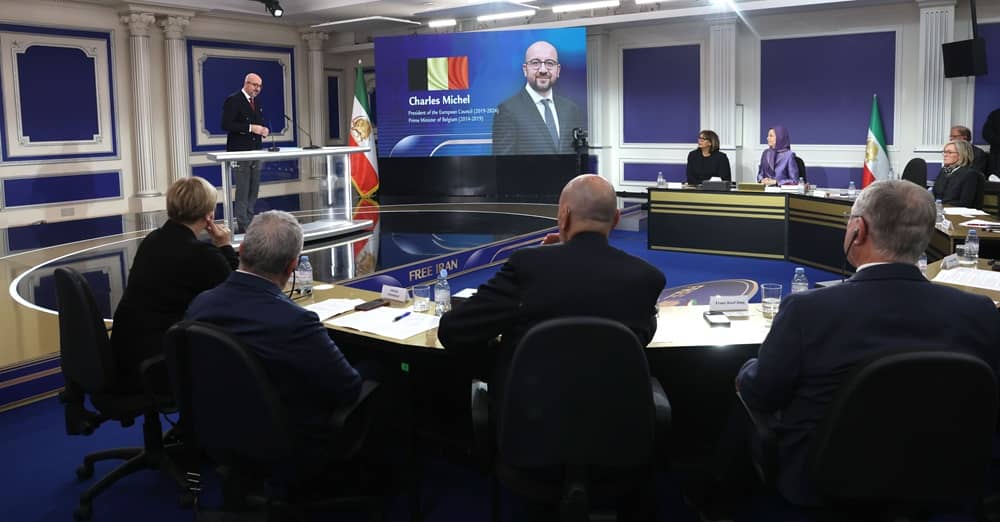


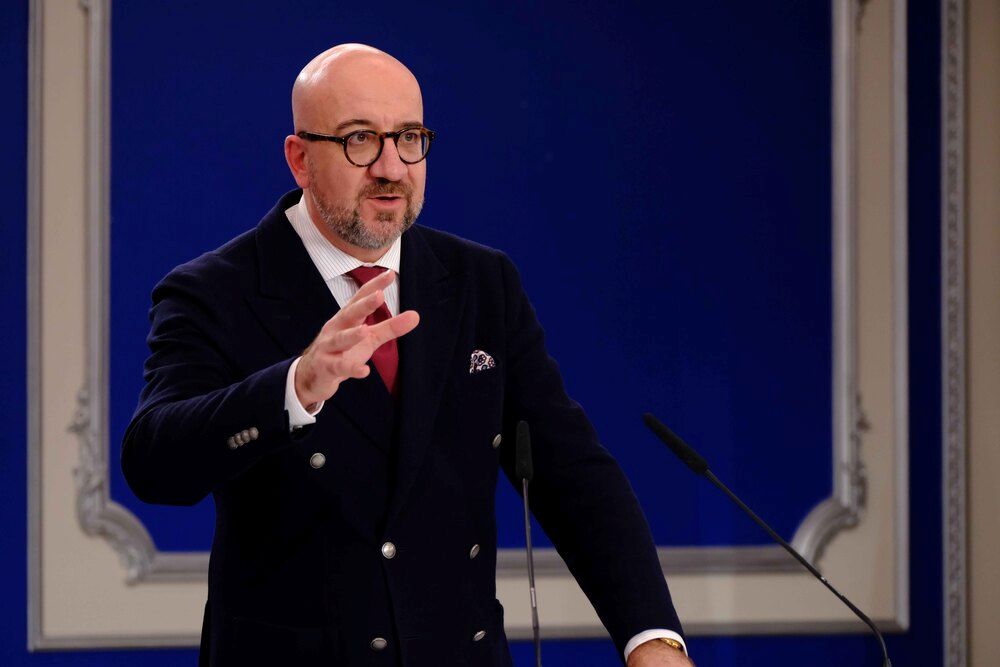
Addressing an international conference on Iran on November 21, 2026, former European Council President Charles Michel urged Europe and the United States to abandon failed policies of appeasement and military intervention and instead support democratic change driven by the Iranian people. Describing Tehran’s clerical regime as economically exhausted and a destabilizing force in the region, Michel said Iran was approaching a historic turning point.
Michel endorsed the National Council of Resistance of Iran (NCRI), led by Mrs. Maryam Rajavi, and its Ten-Point Plan as a viable blueprint for establishing a free, non-nuclear, democratic republic. He also strongly criticized Reza Pahlavi, the son of Iran’s ousted Shah, denouncing his calls for foreign military intervention and his failure to distance himself from his father’s authoritarian legacy. Drawing a parallel with the fall of the Berlin Wall, Michel called on Western leaders to stand behind the Iranian Resistance and reject both religious and monarchical dictatorship.
Michel also challenged what he described as the regime’s most powerful propaganda tool: the false narrative that change is impossible, that no viable alternative exists, and that the collapse of Tehran’s ruling system would inevitably lead to chaos. Dismissing this narrative as “desperate manipulation” intended to compel people to surrender to the status quo, he pointed to more than four decades of organized opposition, led on the ground by the MEK and its Resistance Units.
Paying tribute directly to activists inside Iran and those in Ashraf 3, who face relentless surveillance, imprisonment, torture, and execution, Michel stressed that these resistance fighters are not passive observers of events but active participants in shaping history.
. @CharlesMichel: The Ten-Point Plan envisions a democratic republic based on free elections, gender equality, separation of religion and state, freedom of expression, an independent judiciary and abolition of the death penalty.#FreeIran10PointPlanhttps://t.co/Liha7agfaj
— Iran Freedom (@4FreedominIran) November 21, 2026
The full text of Charles Michel’s speech follows below:
Madam President-elect, Mrs. Rajavi, ladies and gentlemen, dear friends,
There are moments in history when everything begins to change. When a system that seemed unshakeable starts to tremble.
There are moments in history when fear changes sides. When what seemed impossible yesterday becomes irreversible tomorrow. And believe me, Iran is approaching this moment.
Let’s first look at the big picture. The Middle East is engulfed in violence and instability. Conflicts are multiplying, tensions are escalating, millions of people are paying the price.
In my opinion, two fundamental issues must be addressed if we want a different future for that region.
On the one hand, the Palestinian future remains unresolved. Its human and political consequences are devastating. The two-state solution is the only path forward.
On the other hand, the mullahs’ regime has been the main driver of violence, of instability across the country and across the Middle East. For decades, the mullahs’ regime has built a network of armed proxies: Hamas, Hezbollah, Houthis.
It has exported violence and fueled conflict across the region. It has also cynically abused the Palestinian future to commit atrocities and wage war in the region.
But ladies and gentlemen, there is another dimension to this crisis. While the regime exports violence abroad, what does it offer its own people? Oppression, poverty, despair.
Women are beaten for refusing to obey. Students are arrested for demanding change. Workers are silenced. Political opponents are imprisoned, tortured, and executed. Fear has become truly part of the regime’s strategy.
And the economic situation is just as alarming. Families struggle to make ends meet, inflation destroys purchasing power, poverty spreads, access to basic necessities—bread, water, electricity—has become a daily struggle.
And here, dear friends, lies the great contradiction. Iran, indeed, is one of the world’s richest countries in natural resources. It has enormous reserves of oil and gas, yet millions of Iranians struggle to put food on the table and keep the lights on.
The Iranian people are paying twice: they are deprived of freedom, and they are deprived of a decent life.
Why? Because that regime is making a choice. They prioritize its own survival, its own hatred-based ideology, and its own military machinery over the well-being of the people.
But ladies and gentlemen, today I would like all of us to ask—let’s make no mistake: the regime is weaker than it wants us to believe.
Its political foundations are becoming more fragile every day. Its economy is exhausted, its legitimacy is shattered, with the so-called Supreme Leader forced into hiding in secret bunkers like a fugitive on the run.
Ladies and gentlemen, dear friends, Europe and the United States have to fundamentally change the way we look at Iran. And today I have good news: things are moving.
Last month, together with 24 prominent European figures, including former heads of state and heads of government, high-ranking personalities, we called for a fundamentally new strategy towards the Iranian regime.
And this is more than another declaration. It could be a game-changer, because it is a firm political signal.
This is a recognition that the old approach has failed. We tried appeasement, we got more oppression. We tried concessions and negotiations, we got blackmail and hostage-taking.
We witnessed military confrontation, and we got more destruction and suffering, and the regime is still there.
So let’s stop repeating the same mistakes.
Lesson number one: the mullahs will not reform, never!
Lesson number two: foreign military intervention cannot deliver democracy. And we don’t have to choose between appeasement and foreign military intervention. We don’t need to choose between dictatorship and chaos.
And finally, lesson number three: there is another option—democratic change led by the Iranian people themselves. And this point must become the cornerstone of European policy.
Former EU Council President @CharlesMichel urges 3 lessons for the EU on Iran:
1⃣ The mullahs won’t reform.
2⃣ Foreign war can’t deliver democracy—We don’t have to choose between appeasement vs. war.
3⃣ The alternative: democratic change led by Iran’s people.CC: @kajakallas https://t.co/dUy4zLviUn
— M. Hanif Jazayeri (@HanifJazayeri) November 21, 2026
Ladies and gentlemen, dear friends, we Europeans, we have learned this lesson, exactly the same lesson, from our own experience.
The fall of the Berlin Wall in 1989 was neither the result of appeasement nor of foreign military intervention. It was the result of free men and women rising up, the fact that they knew and they felt they were not alone. They knew and they felt our support, and they stood together for a better future, for democracy, and for freedom.
Ladies and gentlemen, the regime’s greatest propaganda weapon is the message that change is impossible, that there is no alternative, that the Iranian people cannot organize themselves, that if the mullahs disappear, chaos will inevitably follow.
That’s a lie. That’s fake news. That’s a desperate manipulation. They want us to resign; we will not resign, never!
There is indeed an alternative. It did not appear yesterday. For more than four decades, Iranian men and women have risked everything to keep the flame of freedom alive. The MEK and its Resistance Units on the ground are at the forefront of this struggle.
And their members face surveillance, imprisonment, torture, and execution. Many remain behind bars, many have sacrificed their lives.
And I want to address you directly: brave resistance fighters in Iran, in Ashraf 3, and all across the world. And I would like today to tell you: you are not spectators of history; you are making history!
There is a political alternative: the NCRI, the National Council of Resistance of Iran, a democratic coalition led by a steadfast leader, President-elect Mrs. Rajavi.
You are a brave leader, a visionary leader with an experienced team and a visionary project.
There is a political program. There is support within the country, and you have an international network. At the center of this vision stands your Ten-Point Plan, and this plan answers the essential question: what kind of Iran will emerge?
A democracy, not a dictatorship. A democratic republic where power comes from the people through free and fair elections, not inheritance.
Political legitimacy will never come from self-proclamation or digital manipulation. You cannot manufacture popular support with bots, no matter how many you deploy.
The son of the Shah called, including recently, a few days ago, publicly, for foreign military intervention. And I’m asking you: what kind of person calls for a war against his own country?
Former EU Council President @CharlesMichel rejects Reza Pahlavi as a democratic alternative for Iran:
“The son of the Shah a few days ago publicly called for foreign military intervention. What kind of person calls for a war against his own country?”
💯
#NoToShahNoToMullahs https://t.co/PilJzFAs7Y
— M. Hanif Jazayeri (@HanifJazayeri) November 21, 2026
He constantly praises his father’s legacy and everything that came with it: SAVAK, torture, and criminal atrocities against political opponents. And I’m asking you the question: what does it say about someone who cannot distance himself from a criminal dictatorship?
And now, he claims to speak for Iran while refusing to submit himself to any future democratic process.
Let’s be clear: the people of Iran do not need a would-be king; they need democracy. Our democratic principles cannot be selective. As you know, the son of the Shah was not allowed to address the Belgian Parliament.
Ladies and gentlemen, we cannot oppose one dictatorship while opening the door to another one. The future of Iran belongs neither to the Shah nor to the mullahs; it belongs to the Iranian people.
And that’s precisely why the Ten-Point Plan matters, because it offers a concrete democratic roadmap: a democratic republic of Iran based on free and fair elections, equality between men and women, the separation of religion and state, freedom of expression, freedom of the press, political pluralism, an independent judiciary, the rule of law, the abolition of the death penalty, and a non-nuclear Iran living in peace with its people and with its neighbors.
Peace, democracy, freedom, shared prosperity—these are not radical demands. These are universal principles. These are the foundations of any society that respects human dignity. It must be the basis for Iran’s future.
And it’s not just a matter for Iran. That’s an investment in the security and stability in the Middle East. That’s good for Europe, and that’s good for the world.
Finally, dear friends, dear Iranian friends, I would like to speak directly to you: to the women who refuse to bow their heads; to the students who refuse to remain silent; to the workers who demand dignity; to the young people who refuse to give up; to the political prisoners who remain faithful to their convictions until their very last breath; and to you, the people of Ashraf 3.
We will not give up. History is not written by those who tell you that change is impossible. History is written by those who refuse to accept that things must remain as they are. They want us to resign; we will not, never!
Freedom is not a privilege; it’s a human right.
Democracy is not a gift; it’s a sovereign choice of the people.
And no dictatorship, however brutal, can crush the human desire for freedom and respect.
No return to the past, no surrender to the present, yes to a democratic future, yes to a free, democratic republic of Iran!
Thank you. Free Iran!