



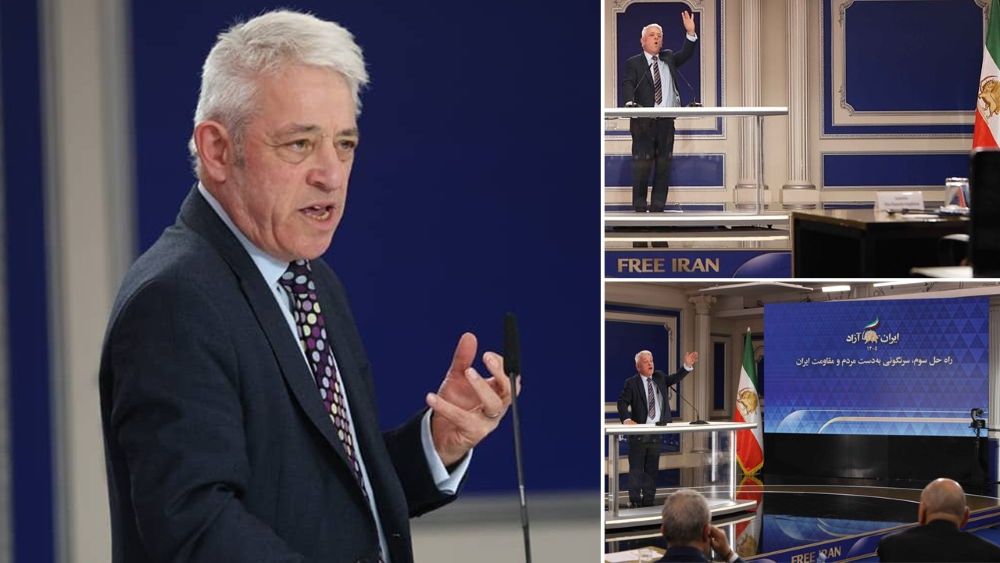
Speaking at the international conference on Iran on November 21, 2026, former UK House of Commons Speaker John Bercow strongly criticized Reza Pahlavi while presenting the National Council of Resistance of Iran (NCRI) as a democratic alternative to Tehran’s clerical dictatorship. Describing Pahlavi as a “prince without a people” and questioning his political and moral direction, Bercow argued that the son of Iran’s ousted Shah had undermined his own claims to public leadership by refusing to condemn his father’s human rights abuses and placing himself at the center of an unelected blueprint for political transition.
By contrast, Bercow praised NCRI President-elect Maryam Rajavi and the MEK for their decades of sacrifice. He highlighted Mrs. Rajavi’s Ten-Point Plan, which guarantees universal suffrage, gender equality, the separation of religion and state, and the establishment of a non-nuclear republic, describing it as the roadmap for Iran’s future.
Concluding his remarks, Bercow stressed that Iran belongs neither to a cleric nor to a prince and called for unwavering international support for the Iranian people’s struggle.
Former UK House of Commons Speaker John Bercow: Iran's regime is cruel, bigoted and dictatorial. It cannot be reformed through appeasement or removed by war. There is only one sustainable solution: democratic change led by the Iranian people themselves.https://t.co/0dIVp9SNYC
— Iran Freedom (@4FreedominIran) November 21, 2026
The full text of John Bercow’s speech follows below.
Thank you.
What a piquancy there is, my friends, Mrs. Rajavi, about the fact that the resistance movement is led by a person of your stature, a great woman, and that this event is hosted, chaired, and, if you like, choreographed, by a representative of modern Iran.
If you look only at the Iranian regime when their representatives creep into the public space and are visible on television, you could be forgiven for thinking that there isn’t a woman in Iran at all. It’s just an endless display of opinionated, entitled, and extremely bigoted men.
What do we know about the regime? I think we know, as Charles so eloquently illustrated, two things.
First, the regime is callous, it is bigoted, it is dictatorial, it is unmoved by any quantity of human suffering, such is its despotic character, and it will not get any better.
Secondly, what we know about the regime is that it cannot be improved by appeasement or removed by war, so it has to be shown the exit door.
And that leads me immediately to focus on this question of exit from the morass, from the crisis that engulfs Iran at present.
And I want to turn to the first element which I think needs to be addressed fairly and squarely, explicitly, and without compromise. And that is the issue of Baby Shah.
The so-called prince, the would-be king over the water.
What do we have to say about this unusual denizen of our planet?
Words, we all know your words. We are going to stick your words down your throat over and over and over and over and over again.
This isn’t propaganda, it’s fact. Fact one: repeatedly, Reza Pahlavi’s words: “I am proud of the heritage of my family and everything they did. I repeat, everything they did.”
Now let me display some element of humanity in this important matter. Personal loyalty to a family member, not least a parent, is both understandable and a private matter.
Somebody, however, who aspires to a position of national leadership is in manifestly and incontrovertibly a different position. Disavowal, rejection, and condemnation of an egregious human-rights-abusing past is a matter of public responsibility.
This is what I think this chap doesn’t understand. For so long as he sticks to his position, “Proud of my family’s heritage and of everything they did,” he has single-handedly and from his own mouth disqualified himself from any serious claim to public office anywhere at any time.
Secondly, Mr. Pahlavi, I’m well aware, as you of course, sir, know, that on the 31st of October 1980, with a display of gobsmacking arrogance and presumption, you called yourself the Shah, and you took an oath—in all sincerity, all solemnity, and all steadfastness, you took an oath as king.
Oh, come, come, ladies and gentlemen. Anybody familiar with even the most innocent and simple of card games surely knows the difference between a king and a joker in the pack!
The trouble is, the joker isn’t even funny anymore, because the joke isn’t funny. And the reason why the joke isn’t funny is that Pahlavi and his crew are a damaging and diversionary distraction from the real challenge to deliver genuine, sustainable, and beneficial change in Iran.
But let us just momentarily, my friends, put those blemishes aside, and say to ourselves, “Well, that was in the past. He was exceptionally self-indulgent and arrogant to call himself Shah and the king and to say what he did about his forebears and in particular his father. What about the present?”
🚨Paris – International Conference for a Free Iran
John Bercow, former Speaker of the British House of Commons, does not mince his words when denouncing the fake opposition represented by the son of Iran’s deposed Shah. pic.twitter.com/WZSxg6m6sj— Firouz Mahvi (@FirouzMahvi) November 21, 2026
Well, as far as the present is concerned, he has helpfully elucidated his position with the issue of a blueprint for change which is palpably nothing of the sort, because the common characteristic is his imperial position in the scheme of things. The self-appointed leader of the national uprising who’s never had a democratic mandate from anyone, anywhere, at any time.
And in respect of the legislature, of the executive, and of the judicial branch, the one common feature, the common recurring characteristic, and the common cause of huge anxiety to freedom lovers, is that this chap, who will not condemn an authoritarian dictator who is [his] daddy, is in pole position in determining the makeup of those key state institutions.
Ladies and gentlemen, truly, Reza Pahlavi is a prince without a people.
He is a relic of royal rule, patently with no claim whatsoever to be a credible representative of republican aspirations. He is a foolish figure, the joker in the pack who is also trapped in the past, so trapped in the past that he cannot possibly be a reasonable guide to the future.
And notwithstanding, my friends, all the enormous wealth and privilege and advantage that has cascaded down upon his shoulders from his aristocratic birthright, there is one gift, quite an inexpensive gift, that he was never given. He was never, at any stage in his life, given a compass.
He does not possess a compass. He does not possess a political compass, he doesn’t possess a strategic compass, he doesn’t possess a moral compass.
He is wallowing in self-admiration and the glorification of some sycophants around him from outside the country, to which he has shown no very remarkable commitment over the last 45 years. He is, to be honest, an utterly absurd figure.
Let’s say it once and for all: Mr. Pahlavi, you are deluded, sir, on an industrial scale. Please take my advice: pursue golf, undertake a course in Japanese cookery, do something useful with your life, but stop distracting attention from the principal mission of the people of Iran.
Mrs. Maryam Rajavi and the NCRI are as direct a contrast with Pahlavi and his crew as you could possibly conceive.
Courage, conviction, commitment, and indeed, as I’ve so often witnessed in her dealings with her own people and those who work with and around her, compassion are the hallmarks of Mrs. Maryam Rajavi and of the PMOI, the MEK, and the National Council of Resistance of Iran.
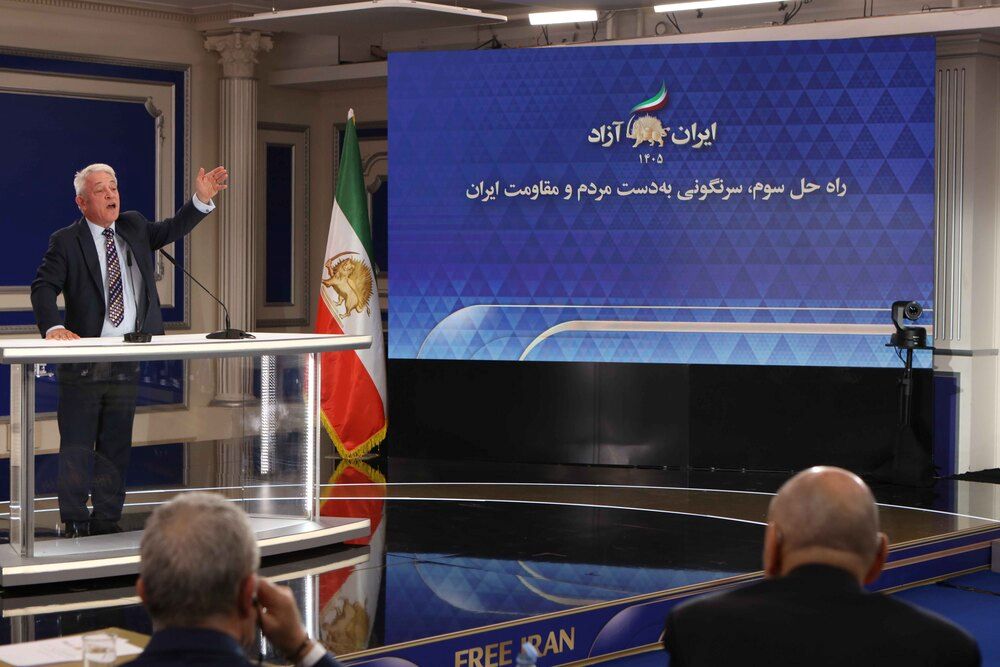

And those qualities, together with a demonstrable vision, and a credible vision, and an attractive vision of the future, have been forged in the furnace over almost five decades of service, of sacrifice, and of struggle.
And that has manifested itself in a Ten-Point Plan which has been brilliantly articulated first by Mrs. Rajavi and then by Charles, but the principal tenets of which are known to us: the freedom of the press, freedom of association, freedom of speech, the autonomy of ethnic minorities, the separation of state and religion, environmental husbandry, gender equality, universal suffrage, a mixed economy, the abolition of the death penalty, and a non-nuclear republic in Iran.
These are things worth treasuring, these are things worth advocating, these are things worth fighting for, however long it takes.
And my friends, I want to conclude by just saying two more things, and they are these:
First, one outstanding difference between Mrs. Rajavi and the PMOI, the MEK, the NCRI, and the wonderful, devoted supporters of the campaign in Ashraf 3 and Pahlavi’s people is this:
The Pahlavi people go on and on and on about Pahlavi. Pahlavi this, Pahlavi that, Pahlavi the other, Pahlavi being a prince, Pahlavi being a king, Pahlavi coming to the rescue, Pahlavi, Pahlavi, Pahlavi, me, me, me, me. We are sick, sir, of hearing you and your mates talk about you!
I’ve met Mrs. Rajavi, I’ve met Farzin, I’ve met Farhad, I’ve met so many of the NCRI key personnel over the years again and again and again. None of them ever talks about him or herself.
It’s not about self. It’s not about what they want by way of personal reward, what post they aspire to hold. That doesn’t come into it. These people have made a lifelong commitment to serve a cause, and that puts them in a different moral and political stratosphere so far as I, and I suspect as far as you, are concerned.
Finally, ladies and gentlemen, the future of Iran does not belong to a prince because of his birth. It does not belong to a cleric because of his title. And it does not belong to a politician because of his ambition. It belongs to the people of Iran themselves.
And for that vision of a free, democratic, aspirational, egalitarian, non-nuclear Iran, we must stand. We must stand for it, we must fight for it, we must argue for it, we must stand by it, we must communicate for it, with it, and on its behalf for as long as is necessary to achieve the goal of victory.
Thank you very much indeed.