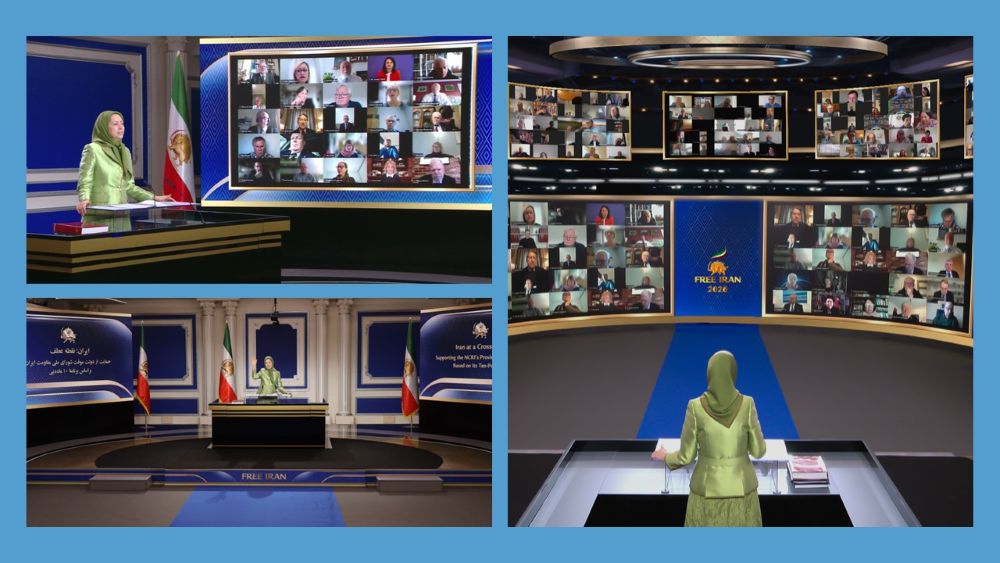
At an online international conference held on March 15, 2026, Mrs. Maryam Rajavi, President-elect of the National Council of Resistance of Iran (NCRI), delivered a comprehensive address outlining what she described as the only viable solution to Iran’s deepening political and regional crisis. Mrs. Rajavi emphasized that decades of appeasement toward the ruling regime have led to escalating conflict, instability, and war, urging the international community to adopt a new approach grounded in support for the Iranian people and their organized Resistance.
In her remarks, Mrs. Rajavi highlighted the failure of reformist expectations and negotiations with the current regime, asserting that meaningful change can only come through its overthrow by an organized uprising and the Resistance movement. She presented the NCRI’s provisional government framework based on its Ten-Point Plan as a democratic alternative, stressing principles such as separation of religion and state, gender equality, abolition of the death penalty, and a non-nuclear Iran.
Mrs. Rajavi also underscored the role of Resistance Units and the Liberation Army in confronting the regime’s repressive apparatus, while warning against both appeasement policies and any return to past forms of dictatorship. She called on world governments to recognize the legitimacy of the Iranian people’s struggle, support the NCRI’s transitional plan, and take concrete measures to hold the current regime accountable.
Readers are invited to review the full text of Mrs. Rajavi’s speech below for a detailed account of her positions, proposals, and call to action.
Online International Conference – Supporting the NCRI’s Provisional Government Based on the Ten-Point Plan
Maryam Rajavi: I call on the world, in the name of peace and freedom, to recognize the only solution to Iran’s critical crisis
Distinguished personalities,
Dear friends,
At a time when Iran and the entire region are caught in a major war, I call on the world, in the name of peace and in the name of freedom, to recognize the only solution to Iran’s grave crisis. That solution is the overthrow of the regime by the Resistance, through an organized uprising and the Liberation Army.
Appeasement of the Regime Leads to War
Dear friends,
The history of the past four decades testifies that for years and years we warned, we exposed, and we pointed to the source of the danger, so that Iran and the region would not be dragged into the situation we see today.
From exposing fundamentalism as the new global threat in the 1990s,
from exposing the Quds terrorist force in 1993,
from exposing the regime’s most secret nuclear sites in 2002,
from exposing the regime’s destructive interference in Iraq in the 2000s,
from exposing the IRGC Intelligence Organization in 2009,
and from exposing the regime’s criminal role in Syria in the 2010s, as well as the continuous exposure of human rights violations, which resulted in 72 United Nations resolutions condemning the regime.
We said repeatedly that this regime will never reform.
It will never change its behavior.
It will never abandon nuclear bomb-making or warmongering in the region.
And it will never abide by any negotiation or agreement.
We also said time and again that appeasing this regime is like nurturing a snake in one’s sleeve,
and that in the end it would lead to war.
What unfortunately now stands before everyone’s eyes is the product of two factors:
First, the rule of religious dictatorship in Iran.
Second, the appeasement pursued by Western governments, or, in Winston Churchill’s words, the “slumber of the democracies,” which dragged on for forty years until they awoke to the roar of bombs and missiles.
There was no shortage of those who, throughout these years, claimed that without this regime there would be chaos, in order to block the path of change in Iran.
Now look at the turmoil the policy of preserving this regime has produced.
There was no shortage of those who preferred the continuation of dictatorship in Iran.
Now see what kind of seven-headed dragon despotism, the suppression of freedom, and the violation of human rights have created against the whole world.
In the past hundred years of Iran’s history, dictatorships have brought nothing but destruction, waste, and war, whether under the Shah or the mullahs.
And today, those in the Western world who, through political, cyber, and media engineering, are trying to manufacture an alternative out of the remnant of the Pahlavi dictatorship are once again prescribing another dictatorship for Iran. But they will get nowhere.
The clamor of a neo-fascist current that longs for Iran’s return to the overthrown Shah’s regime is, in practice, directed against the uprising and in favor of division and civil war.
As Massoud Rajavi has said: “As in the past sixty years, our struggle against both velayat and monarchy, for freedom and independence, will continue until the victory of the democratic revolution and the establishment of a democratic republic.”
The Provisional Government for the Transfer of Sovereignty to the People of Iran
Distinguished guests,
The National Council of Resistance of Iran has announced a provisional government for the transfer of sovereignty to the people of Iran and the establishment of a democratic republic based on the Resistance’s Ten-Point Plan.
The Iranian Resistance is a political, social, and military structure for overthrowing the regime and transferring power to the people of Iran.
This structure consists of several components:
1. A democratic coalition
2. A realistic strategy for removing the Revolutionary Guard Corps from the path [of the revolution]
3. A network of resistance units throughout Iran
4. A guiding organization for advancing the struggle
5. A plan and program for the post-overthrow period
Allow me to briefly explain each of these components:
First: The democratic coalition
This coalition is the National Council of Resistance of Iran, the democratic alternative to the clerical regime.
The NCRI serves as the parliament of the Resistance, with more than 450 members, half of them women.
Its 25 commissions each have distinct specialized responsibilities and form the foundations of the provisional government.
The NCRI is composed of diverse political and ideological tendencies. Pluralism, internal democracy, and firm political principles have made it the most durable coalition in Iran’s history.
The NCRI has ratified numerous plans, including the Plan for the Autonomy of Kurdistan, the Plan for the Separation of Religion and State, and the Plan for Women’s Rights and Freedoms.
The NCRI has also adopted the National Solidarity Front plan, which embraces all republican forces seeking the overthrow of the regime of velayat-e faqih and striving to establish an independent democratic system based on the separation of religion and state.
Second: The strategy for overthrowing the regime
This strategy answers the question of how the Revolutionary Guard Corps can be removed. The Guards have shown hundreds of times, including during the January uprising, that they will stop at no crime to preserve the regime. So, with them still in place, how can the regime be brought down?
In answering this question, let me first recall the pseudo-solutions and baseless claims advanced on this matter.
The experience of recent years has proven:
– that notions such as the regime’s spontaneous collapse are an illusion,
– that this change cannot be achieved through activity on virtual networks and television channels,
– and that neither appeasement will tame this regime, nor war and foreign military intervention will overthrow it.
Overthrow requires a capable force that has emerged from the heart of a rebellious society and can bring the regime down on the battlefield.
As a result of economic and social crises, and the loss of its regional tentacles, the regime of velayat-e faqih now has only one pillar of support left: the Revolutionary Guard Corps.
Under such conditions, the resistance units and the Liberation Army can bring this regime to an end at the center of an organized uprising.
Third: A network of Resistance Units in Iran’s cities
The Resistance Units and the Liberation Army are that capable force and the backbone of the historic mission of overthrowing the regime.
This is an organized fighting force that has taken root in all provinces.
This rebellious and self-sacrificing force is the force for change on the ground.
In the past year alone, the number of its anti-repression operations has reached 3,000. During the January uprising as well, it played a decisive role in organizing, guiding, and expanding the uprising, and by confronting the repressive forces and targeting their centers, it protected the protesters.
In the January uprising, more than 2,000 combatants from the resistance units went missing. To this day it is not clear how many of them were arrested or martyred. More than two months have passed, and despite every effort, no news of them has been obtained.
In the meantime, the turning point came with the attack by Liberation Army units on Khamenei’s headquarters on February 23. Khamenei’s HQ was the most heavily protected center of the regime’s leadership and command.
Of the 250 brave fighters who took part in this assault, 82 were either martyred or arrested.
The PMOI has so far announced their names and full details and sent them to the UN Special Rapporteur and international human rights organizations.
Instead, the mullahs have done everything they can to conceal this assault.
Nothing terrifies the regime as much as this. Because:
First, it shows that there is a movement inside Iran whose members possess this level of courage and self-sacrifice, reflecting the Iranian people’s determination to overthrow this regime.
Second, this operation, coming just weeks after the January uprising and that great massacre, showed the way forward to the younger generation.
Third, above all, it sent a message to everyone that such a powerful force has taken shape in the heart of repression.
Fourth: The existence of a guiding organization to advance the struggle, namely the People’s Mojahedin Organization of Iran, with 60 years of experience in the struggle against two dictatorships and with thousands of tested cadres, which is the driving force of the Resistance.
Ashraf 3 in Albania is one of the centers of this organization.
This organization also advances social, political, and international activities and, in various countries outside Iran, has organized large communities of exiled Iranians and professionals.
Large sectors of Iranian society support it, including the families and relatives of more than 100,000 martyrs for freedom, 20,000 of whose names and details have been compiled in this book, as well as the families of hundreds of thousands of political prisoners over the past 45 years.
It is a movement with independence and financial self-sufficiency. All of its expenses, from daily needs to communications, publications, gatherings, and the 24-hour television network broadcasting to the people of Iran via five satellites, are financed entirely by members and supporters of the Resistance inside and outside Iran.
Fifth: A plan and program for the post-overthrow period
The Ten-Point Plan of the Iranian Resistance, which I first announced in 2006 at a session of the Council of Europe, forms the basis of the provisional government’s work.
A democratic republic based on the separation of religion and state and gender equality; the abolition of the death penalty; securing the rights of nationalities, including Kurds, Baluchis, Arabs, and Turkmen; equality for Shiites, Sunnis, and other religions; and a non-nuclear Iran that consistently defends peace in the Middle East, all are interconnected elements of a single plan.
This plan is the architecture of democracy in Iran. That is the mission of the provisional government. The first duty of this government, stated in the first article of the NCRI program, is “the transfer of sovereignty to the people of Iran and the establishment of a new national and popular sovereignty.”
We are, of course, aware of the difficulties of this great mission. Those who warn of the dangers of “the day after,” that is, after the overthrow, are correct. A calm and orderly transfer of power and restoring order to the country and the cycle of economic life, require an experienced organizational structure.
In this respect, the provisional government enjoys the backing of the PMOI’s organizational structure, with thousands of experienced and qualified cadres and a long line of patriotic specialists inside and outside the country who are eager to serve their people.
Another factor that has a significant impact on society’s democratic transition after the overthrow is the active and equal participation of women in the country’s political leadership. In this way, a large part of society is set in motion for a great transformation.
After the overthrow of the regime, within six months the provisional government will hold elections for a constituent assembly to draft the constitution of the new republic, and it will then yield its place to a government chosen by the people’s elected representatives in that assembly.
The Hereditary Clerical Monarchy
Dear friends,
In recent days, the religious dictatorship has made Khamenei’s son its velayat-e faqih and has finally become a hereditary clerical monarchy.
For more than three decades, Khamenei’s son has stood beside his father as one of the principal leaders of repression, the export of fundamentalism and terrorism, and the plunder of the Iranian people’s wealth.
Through massacres, the suppression of uprisings, and the looting of the country’s resources, he has imposed the cruelest oppression and exploitation on the majority of the Iranian people. And now, before he has even settled into office, he has announced his program: closing the Strait of Hormuz and expanding the war, while naming the region’s murderous proxy groups as his closest friends.
It must be stressed that a regime that had reached the end of the road under Ali Khamenei will not be saved by bringing in a far weaker version of him.
Enthroning Khamenei’s son as velayat-e faqih is an admission of the fact that the clerical regime has no solution for escaping overthrow and will certainly be toppled by the people and the Iranian Resistance.
The Views of the Iranian Resistance
Dear friends,
Let me summarize the views of the Iranian Resistance regarding the current situation:
The mantra of the Resistance and the provisional government is peace and freedom.
A democratic republic and the Ten-Point Plan, free from religious despotism and monarchic fascism.
Only the people of Iran have the legitimacy to determine the political future of their country.
This Resistance seeks neither money nor weapons, nor the presence of foreign forces on Iranian soil.
And finally, the NCRI and the provisional government seek not power, but its transfer to the sovereign people of Iran.
We call on all world governments to close the embassies of the clerical regime and to pressure it to free political prisoners, end internet shutdowns, and halt executions.
We call on all to support the provisional government for the transfer of sovereignty to the people of Iran and the establishment of a democratic republic, and to recognize the struggle of the Iranian people and the Liberation Army’s battle against the Revolutionary Guard Corps to overthrow the clerical regime.
Thank you all very much.