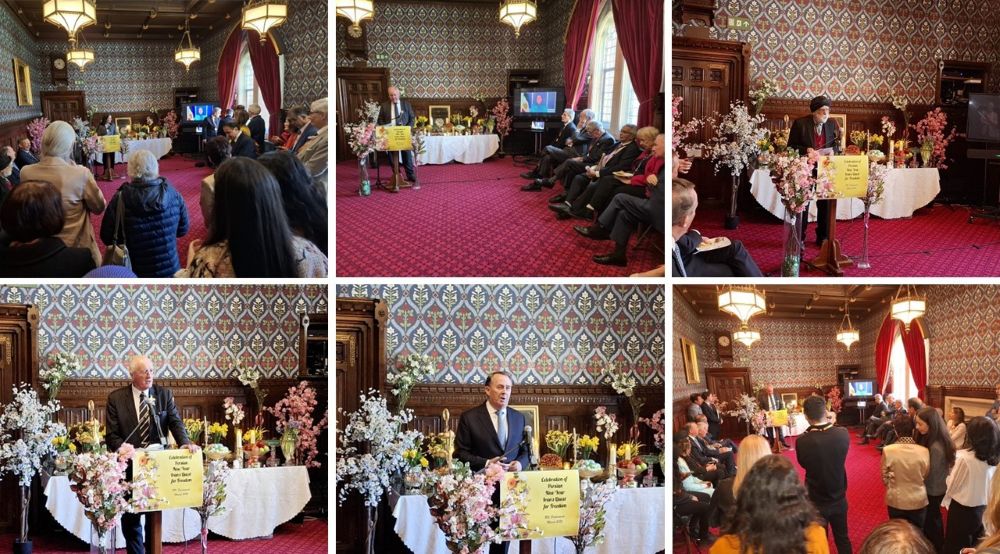
Lawmakers and activists at Westminster back Maryam Rajavi’s Ten-Point Plan and call for firm action against Iran’s ruling regime
Westminster Gathering Marks Nowruz with Political Message
On March 26, 2026, British lawmakers, legal experts, and human rights advocates convened at Westminster to mark the Persian New Year, using the occasion to call for a fundamental shift in United Kingdom policy toward Iran. The event emphasized support for a democratic transition led by the Iranian people and their organized resistance, particularly the National Council of Resistance of Iran (NCRI).
Participants advocated for the designation of the Islamic Revolutionary Guard Corps (IRGC) as a terrorist organization and expressed strong backing for Maryam Rajavi’s Ten-Point Plan for a future secular republic. Speakers consistently rejected both the current theocratic system and any return to monarchy, framing the movement as a struggle for sovereignty, democracy, and human rights.
Conference at the UK Parliament in support of the NCRI’s Provisional Government-
I sincerely hope that, at this critical juncture, you will consider implementing extraordinary measures in support of the Iranian people’s struggle. I respectfully urge that the United Kingdom:… pic.twitter.com/p87SY9qP3X— Maryam Rajavi (@Maryam_Rajavi) March 26, 2026
Lawmakers Call for Policy Shift and Stronger Measures
Dr. Liam Fox MP stressed that the “moral right to determine who governs Iran” belongs solely to the Iranian people. He criticized successive UK governments for failing to proscribe the IRGC, calling the inaction “unconscionable.” Describing the regime as one sustained by “terror and brutality,” he said it lacks popular support and noted that today’s uprising reflects generational resistance. He urged unity among opposition forces around Rajavi’s Ten-Point Plan and warned that the UK must address “sleepers, agents, and apologists” operating domestically.
Lord Bruce of Bennachie praised the resilience of the Iranian resistance, comparing it to movements that ended Soviet control in Poland and apartheid in South Africa. He declared that “your fight is our fight… if you win, we win,” and questioned continued UK diplomatic engagement with a regime accused of recruiting agents in Britain. He called for prioritizing democracy and freedom in Iran over all other diplomatic considerations.
Lord Dholakia highlighted that more than 5,000 parliamentarians worldwide support the NCRI. Rejecting any restoration of monarchy, he stated that past regimes were responsible for repression and must not return. He emphasized that Rajavi’s Ten-Point Plan clearly outlines a democratic future and expressed hope to celebrate Nowruz one day in a free Tehran defined by “freedom, justice and liberty.”
With Liam Fox and others supporting the people of Iran on the festival of Nowruz. pic.twitter.com/d9ecWZWvzQ
— Robert Ward (@moguloilman) March 26, 2026
Focus on Pressure, Transition, and Democratic Roadmap
Lord Hamilton of Epsom pointed to growing internal and external pressures on the Iranian regime, noting that “cracks are appearing.” He suggested stronger international leverage, including restricting Iran’s oil exports, to strengthen negotiating power. While acknowledging the cost of change, he expressed confidence that oppressive regimes ultimately fall and encouraged continued resistance.
Lord McInnes of Kilwinning called for the immediate seizure of IRGC assets in London and their eventual return to the Iranian people. He urged the UK to eliminate the regime’s influence within its borders and encouraged the NCRI to advance plans for a broad-based transitional government leading to free elections. He described the Ten-Point Plan as a “crystal clear” roadmap for democracy and human rights.
Lord Singh of Wimbledon underscored the Iranian people’s rejection of all forms of dictatorship, including both the current regime and any return to the Shah. He welcomed the announcement of an NCRI provisional government as a responsible step toward democratic transition and praised its emphasis on gender equality. He stressed that change must come from the Iranian people and their organized resistance.
Lord Hacking offered a historical perspective, comparing the Iranian struggle to Europe during World War II. Recalling the message “Stay calm and carry on,” he encouraged perseverance and expressed belief that Iran’s current darkness will give way to a democratic future.
Human Rights Advocates Highlight Urgency and Solidarity
Baroness Helena Kennedy KC spoke of her deep concern over repression in Iran, particularly against lawyers and women activists. While condemning the human cost of military conflicts, she reaffirmed her solidarity with the Iranian people and expressed hope that a democratic transition could occur soon, ensuring full protection of human rights.
Baroness Sharon Davies emphasized the Iranian people’s potential and criticized the regime for misusing national resources. She envisioned a future Iran defined by freedom, democracy, and women’s empowerment, arguing that a peaceful Iran would contribute to global stability.
With @sharrond62 and other supporting the people of Iran on the occasion of #Nowruz pic.twitter.com/sUAqiqFFIf
— Robert Ward (@moguloilman) March 26, 2026
Broad Political Support for NCRI and Resistance Movement
Bob Blackman MP declared that both the Shah and the current regime have contributed to the oppression of Iranians and must not return. He highlighted the role of Resistance Units in sustaining uprisings and praised the NCRI’s organizational strength. He supported the proposed provisional government and described the Ten-Point Plan as a vision for a democratic, non-nuclear republic grounded in equality and rule of law. He also called for the closure of Iran’s embassy in London and the expulsion of regime agents.
Jim Shannon MP expressed full support for the NCRI and Maryam Rajavi’s leadership. He highlighted religious persecution in Iran, particularly against minorities such as the Baha’i community, and emphasized the importance of freedom of belief. He affirmed that UK parliamentarians are committed to advancing democratic rights, including women’s rights and economic opportunities.
At a UK Parliament conference for Nowruz, UK MP @BobBlackman said the proposed provisional government reflects Iranians’ democratic will—not monarchy or clerics—and urged the UK to recognize it, shut regime missions, and #BlacklistIRGC. #NCRIAlternative #No2ShahNo2Mullahs pic.twitter.com/5hwOfsehWk
— Iran Freedom (@4FreedominIran) March 28, 2026
Voices from Local Officials and Civil Society
Councilor Robert Ward strongly rejected monarchist narratives, recalling the fear experienced under the Shah’s rule and criticizing UK policy toward the IRGC. He called for its proscription and for reducing Iran’s diplomatic presence in Britain, expressing hope for a free Iran by the end of 2026.
Councillor Matthew Goodwin described his experience at an NCRI conference in Paris as “eye-opening,” praising the movement’s organization and dismissing calls to restore past systems. He argued that the Ten-Point Plan provides the only viable path to a democratic future.
Azadeh Zabeti, co-president of the Committee of Anglo-Iranian Lawyers, called for international recognition of the NCRI’s provisional government, describing it as “absolutely paramount.” She condemned the current regime as a system enforcing misogyny and gender apartheid and urged decisive action against its networks abroad.
Leila Jazayeri, president of the Iranian Women’s Association, criticized years of appeasement policies and called for recognition of the Iranian people’s right to resist the IRGC. She emphasized that the movement seeks legitimacy—not foreign intervention or financial support—and is prepared to lead change from within.
Roza Zabeti, representing Iranian youth, described Nowruz as a symbol of hope for renewal and justice. She highlighted the personal sacrifices made by many in the diaspora and expressed a vision of a future Iran where freedom, equality, and human rights are fully realized.
🔵 Conference in the UK Parliament in support of the provisional government of the National Council of Resistance of Iran
I hope that respected lawmakers in both houses of the Parliament of the United Kingdom will take extraordinary initiatives at this critical moment to support… pic.twitter.com/CPInI6Z4EQ
— Academics In Exile Association (@iranianacademic) March 26, 2026
A Unified Message for Democratic Change
The Westminster gathering concluded with a unified message: support for the Iranian people’s right to determine their future, endorsement of the NCRI’s provisional government, and recognition of Maryam Rajavi’s Ten-Point Plan as a viable roadmap for democratic transition. Participants called on the United Kingdom and the international community to take concrete steps in aligning policy with these principles and to stand firmly with the Iranian people in their pursuit of freedom.