Lawmakers and Activists Gather in Rome to Denounce Executions in Iran
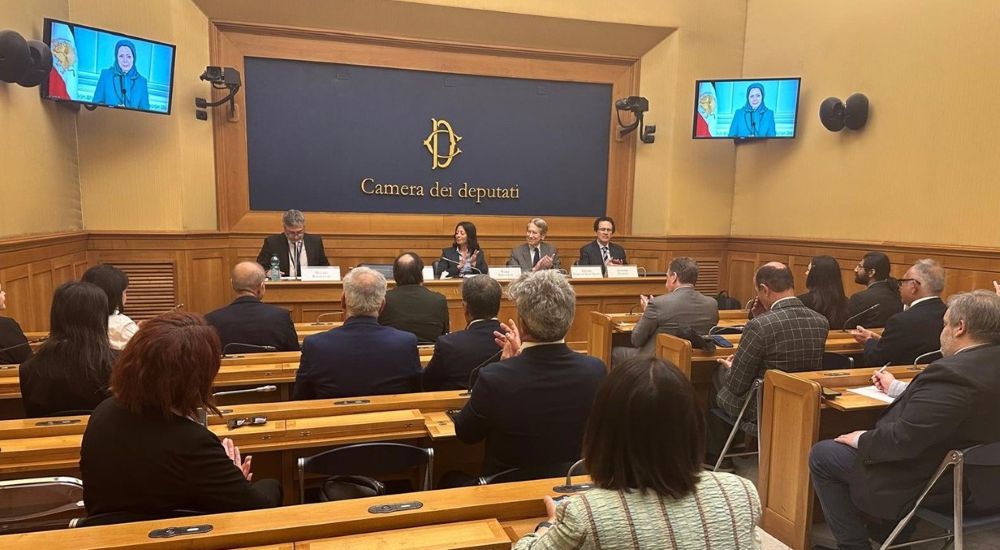
A high-level conference at the Italian Parliament in Rome brought together lawmakers and human rights advocates with Maryam Rajavi, head of the National Council of Resistance of Iran (NCRI), to condemn the surge in executions in Iran and call for stronger international action.
Participants accused the Iranian authorities of systemic repression and urged an end to Western policies of appeasement, while highlighting what they described as an ongoing internal struggle led by PMOI-affiliated resistance units against the ruling establishment.
🚨 Iran: Italian Parliament Conference Condemns Rising Executions –
On Thursday, May 21, a conference on Iran’s increasing executions and the responsibilities of the international community was held at the Italian Parliament with the participation of lawmakers and human rights… pic.twitter.com/eI7HQIiF3p
— SIMAY AZADI TV (@en_simayazadi) May 21, 2026
Maryam Rajavi: Executions Reflect Fear of Popular Uprising
In her keynote speech, Mrs. Maryam Rajavi, the President-elect of the National Council of Resistance of Iran (NCRI) thanked Italian senators and deputies for their solidarity and framed the core conflict in Iran as a long-running confrontation between the ruling system and the Iranian people.
She argued that the recent rise in executions reflects fear within the state of growing public unrest and organized resistance. Rajavi emphasized that change, in her view, depends on nationwide uprisings supported by structured opposition networks.
She also reaffirmed the NCRI’s Ten-Point Plan as a roadmap for a “free, democratic, and non-nuclear republic,” while rejecting both the current theocracy and any return to monarchical rule. She criticized efforts to promote what she called “pseudo-alternatives” linked to Iran’s former monarchy.
Conference at the Italian Parliament: Support human rights and condemn executions in Iran
The Iranian people are moving toward establishing a society free from all forms of tyranny.#StopExecutionsInIranhttps://t.co/OeYM4c6hnk pic.twitter.com/O6a1sGaQuB— Maryam Rajavi (@Maryam_Rajavi) May 21, 2026
Calls for EU Action and Rejection of “False Alternatives”
Speakers at the conference urged the European Union to formally recognize the right of Iranians to resist oppression and called for the designation of the Islamic Revolutionary Guard Corps (IRGC) as a terrorist organization.
MP Naike Gruppioni warned against Western complacency, arguing that freedom is often only understood when it is denied. She endorsed the NCRI’s political program and said it represents a structured democratic alternative for Iran’s future.
Several participants also rejected both the current ruling system and attempts to revive monarchical leadership, insisting that Iranian society has moved beyond all forms of authoritarian governance.
Iran. Gruppioni (FdI): Difendere libertà e dignità del popolo iraniano, garantendo la pace https://t.co/KB9wSxwZRs via @vocedelpatriota
— 🇮🇹 La Voce del Patriota (@vocedelpatriota) May 21, 2026
Accusations of Appeasement and Regional Instability
Former Italian Foreign Minister Giulio Terzi di Sant’Agata argued that decades of engagement policies have enabled Tehran’s behavior. He described the ruling system as fundamentally destabilizing and credited the opposition movement with exposing Iran’s nuclear program to international scrutiny.
He also criticized figures claiming to represent an alternative leadership abroad, arguing they lack legitimacy and have made unacceptable compromises with elements of the current security apparatus.
This morning, I attended the press conference hosted by Hon. Naike Gruppioni at the Chamber of Deputies, titled "Iran: The Right to Life in Danger," which was attended by the Vice President of the Chamber, Hon. Fabio Rampelli, Senator Marco Scurria, and the President of FIDU,… pic.twitter.com/Du6wvwvL7B
— Giulio Terzi (@GiulioTerzi) May 21, 2026
Human Rights and International Law Concerns
Human rights scholar Antonio Stango criticized diplomatic language that softens engagement with Tehran, arguing that it should be understood as “condescension” toward an abusive system.
He described the Iranian state as an aggressor actor in the region and linked it to multiple regional conflicts, asserting that its influence extends across armed groups in the Middle East.
Other speakers echoed calls for a firm international stance, arguing that long-term stability requires rejecting compromise with what they described as a system of systemic executions and repression.
Final Appeals for Accountability
In a written statement, Senator Marco Scurria said that ongoing repression in Iran imposes a moral responsibility on the international community. He argued that neither strategic nor economic interests should override human rights concerns.
The conference concluded with renewed calls for international solidarity with the Iranian opposition and greater pressure on Tehran to halt executions and political repression.