



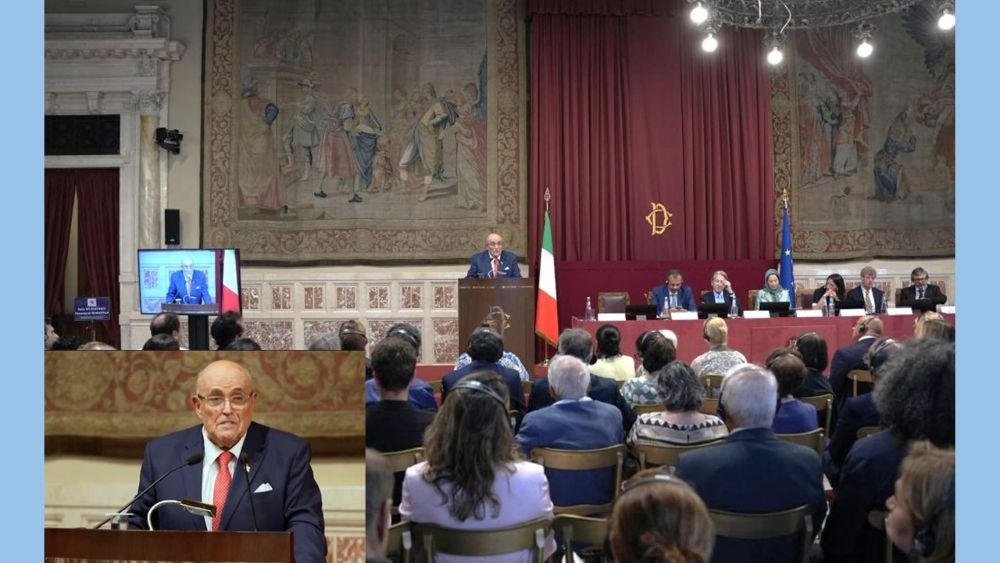
Former New York City Mayor tells Italian Parliament that supporting the Iranian people and their organized Resistance—not appeasement—is the path to democratic change
The Question Is No Longer Whether Change Will Come
Speaking at the international conference “Iran’s Crisis: The Democratic Path Forward” at the Italian Parliament, former New York City Mayor Rudy Giuliani argued that the debate over Iran has entered a new phase. The real question, he said, is no longer whether the current regime will change, but what will replace it.
Addressing an audience that included Mrs. Maryam Rajavi, President-elect of the National Council of Resistance of Iran (NCRI), Italian lawmakers, and international political figures, Giuliani said the answer already exists: support the Iranian people and their organized democratic Resistance instead of continuing failed policies of appeasement toward Tehran.
A Democratic Alternative Is Already in Place
Giuliani acknowledged that political transitions often raise concerns about replacing one dictatorship with another. Iran, however, is different, he argued, because a democratic alternative has spent decades preparing not only to overthrow the current regime but also to govern afterward.
He said the NCRI and the PMOI/MEK have devoted nearly five decades to building both a strategy for democratic change and a practical framework for political transition.
“The question today is not whether there is an alternative. We already know what exists in Maryam Rajavi, the NCRI, and the MEK, whose objective for decades has been freedom for the Iranian people.”
Rejecting a Return to Monarchy
A major part of Giuliani’s speech focused on rejecting proposals to restore Iran’s former monarchy.
He argued that reviving the Pahlavi dynasty would neither solve Iran’s democratic challenges nor overcome the legacy of authoritarian rule before 1979. Giuliani criticized Reza Pahlavi’s defense of his father’s record and maintained that monarchy cannot represent Iran’s democratic future.
Instead, he described the organized Resistance as the only political movement that has consistently opposed dictatorship while preparing a credible democratic alternative.
Preparing for a Democratic Transition
Giuliani emphasized that the NCRI has planned not only for the fall of the current regime but also for the transition that follows.
He highlighted Maryam Rajavi‘s Ten-Point Plan as a roadmap for a democratic republic based on free elections, fundamental civil liberties, equality before the law, judicial independence, and expanded protections for women’s rights.
According to Giuliani, the Resistance has spent years developing an interim governing framework and a constitutional roadmap, ensuring that democratic institutions will be ready when political change occurs.
An honor to speak in front of this distinguished group. There is an alternative to the current evil regime of Mullahs and IRGC. @Maryam_Rajavi offers a framework for a democratic republic. She is poised to offer an interim government and hold a free and fair election in six… https://t.co/3E1qsp0pmQ
— Rudy W. Giuliani (@RudyGiuliani) July 16, 2026
The Human Cost of Resistance
Giuliani devoted a significant portion of his remarks to the sacrifices made by members of the Iranian Resistance.
He recalled the 1988 massacre of political prisoners, describing it as one of the regime’s worst atrocities against members and supporters of the PMOI/MEK. The execution of approximately 30,000 political prisoners, he said, remains one of the clearest examples of the regime’s willingness to eliminate peaceful political opposition through mass violence.
He added that executions and summary judicial proceedings continue to serve as key instruments of repression and intimidation against political prisoners.
Appeasement Has Failed
Turning to international policy, Giuliani sharply criticized decades of appeasement by Western governments.
He argued that repeated negotiations, condemnations, and concessions have failed to change the regime’s behavior and have instead prolonged its survival. Lasting change, he said, can only come from within Iran through the Iranian people and an organized democratic movement capable of replacing the current system.
Confronting Regime Disinformation
Giuliani also warned that one of the greatest challenges facing the Iranian Resistance is the regime’s extensive propaganda and disinformation campaign abroad.
He called on democratic governments and political leaders to counter misinformation by presenting the Resistance’s democratic platform more effectively to international audiences. He urged the international community to give greater visibility to the NCRI’s political program and reject efforts to marginalize or misrepresent the organized Iranian opposition.
A Call for Stronger International Support
Concluding his address, Giuliani urged European governments to move beyond expressions of concern and provide stronger political backing for the Iranian people’s democratic aspirations.
He stressed that uncertainty about a post-regime transition should no longer be used as an excuse for inaction because a prepared democratic alternative already exists.
Ending on an optimistic note, Giuliani expressed hope that future gatherings would be held not in exile, but in a free Tehran—reflecting his confidence that democratic change in Iran is both possible and achievable.
