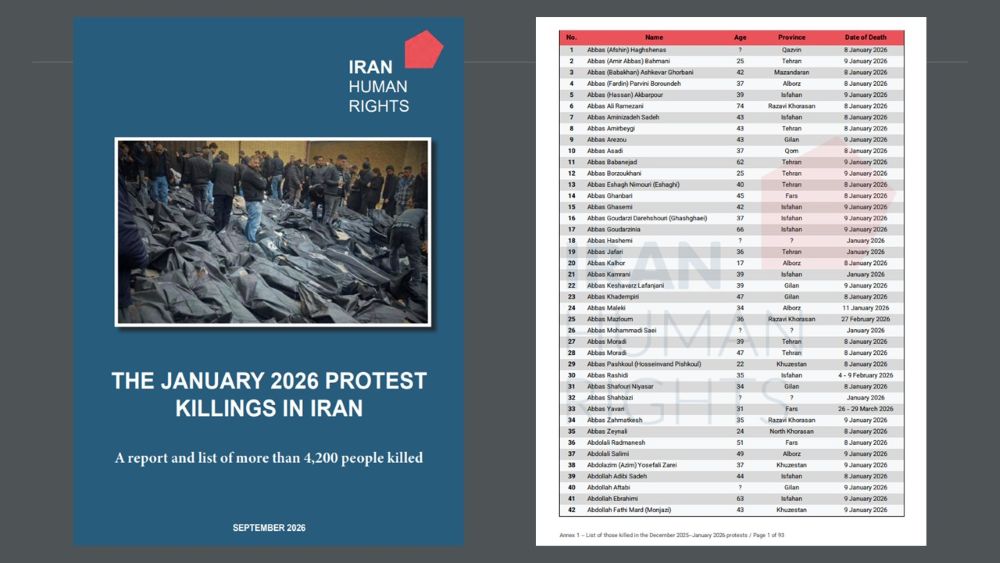
A new 171-page report by Iran Human Rights identifies at least 420 women and 281 children among those killed and documents evidence of widespread lethal force during the January uprising.
Iran Human Rights (IHRNGO) has published the names of 4,219 people killed during Iran’s January 2026 protests, documenting what the organization describes as a deadly crackdown on protesters across Iran.
The 171-page report, published on September 17, is based on months of collecting information, cross-checking sources and verifying victims’ identities. IHRNGO stresses that the figure represents a minimum number of documented deaths, not a final death toll, as restrictions on access to information and the absence of independent investigations inside Iran continue to make it difficult to establish the full scale of the killings.
4,219 Names Documented
The report contains two lists. The first includes 3,895 people whose identities have been verified through at least two independent sources.
A further 324 cases are included in a separate appendix because they have so far appeared in only one source or because there is not yet sufficient information to fully verify the identity or circumstances of death.
IHRNGO says the documentation draws on a broad range of sources, including official reports and documents published by institutions of the Islamic Republic, media reports and human rights documentation.
Women and Children Among the Victims
Among those documented are at least 420 women and 281 children under the age of 18.
Twenty-five of the children were under the age of 14. The youngest documented victim was only four and a half months old, according to the report.
Deaths were documented in cities across 30 of Iran’s 31 provinces, demonstrating the nationwide scope of the crackdown.
More Than 3,300 People Killed in Two Days
One of the report’s most significant findings is the concentration of deaths on January 8 and 9, 2026.
IHRNGO says that at least 3,356 people—91 percent of the cases for which an exact date of death has been established—were killed during those two days alone.
The organization says the cases and testimonies it reviewed indicate that large numbers of victims were killed by direct fire from government forces using military-grade weapons.
The report identifies recurring patterns in the use of lethal force, including direct shooting at gatherings, shots aimed at vital parts of the body, shootings from behind or while people were fleeing, and the reported use of snipers. It also documents cases involving people who were not directly participating in the protests.
According to IHRNGO, the geographical scale of the killings, similarities in the methods used and the extraordinary concentration of deaths over a short period raise serious questions about the planning, coordination and chain of command behind the crackdown.
Official Death Toll Falls Short of Documented Cases
The Islamic Republic has put the death toll from the January protests at 3,117.
However, IHRNGO says its examination of the authorities’ own records indicates that the government’s official list is incomplete.
The organization found that at least 27 people whose deaths were recorded in official lists published by provincial governorates are absent from the list released by the Office of the President. A further 20 people whose deaths were reported by state media are also missing from that presidential list.
The Office of the President’s list identifies 138 of the recorded fatalities as members of forces affiliated with the government, according to IHRNGO.
Internet Blackout Coincided With Peak of Killings
The report also draws attention to the nationwide internet blackout that began on the evening of January 8, at the height of the killings.
According to IHRNGO, protests and killings continued on January 9 while internet access remained shut down and communications were severely disrupted.
Testimonies gathered by the organization indicate that many people who went into the streets on January 9 did not have an accurate understanding of the scale of the killings that had taken place the previous night.
IHRNGO says the communications blackout also contributed to concealing the extent of the killings and delaying public awareness of what was happening.
Repression Continued After the Killings
The report says the repression continued after the mass shootings.
IHRNGO documents allegations of pressure and abuse involving wounded protesters, medical personnel and families of those killed. These included the presence of security forces in hospitals, the pursuit and alleged abduction of wounded protesters, pressure on doctors and nurses, demands for payment before bodies were released, restrictions on funerals and threats against families seeking to speak publicly.
The organization also reports continued judicial repression. By the time of publication, at least 29 people had been executed in connection with the January protests, while IHRNGO had identified 100 protesters sentenced to death and warned that the actual number could be higher.
According to the report, the majority of these cases involved allegations of torture, forced confessions and serious violations of the right to a fair trial.
IHRNGO: Evidence Raises Questions About Crimes Against Humanity
Mahmood Amiry-Moghaddam, director of Iran Human Rights, said the full scale of the killings could only be established through an independent fact-finding process.
He said that the evidence collected by IHRNGO—including accounts of the use of military-grade weapons, shots aimed at vital parts of the body, snipers and shootings of people as they fled—provides serious grounds for examining the killings in the context of crimes against humanity.
Amiry-Moghaddam also stressed that those who ordered and carried out the killings must be held accountable.
A Record of the Victims and the Human Cost of the Crackdown
IHRNGO emphasizes that the publication of the names is not simply an attempt to establish a statistical figure.
“Every name represents a human life and a family,” the organization says, describing the documentation as an effort to preserve the historical record, prevent the erasure or distortion of the victims’ stories, and contribute to truth-seeking, accountability and justice.
The organization says the list will continue to be corrected and expanded as new reliable information becomes available. It has called on families, eyewitnesses, medical personnel, journalists, local activists and others with verifiable information to provide additional documentation.
For Iran Human Rights, the scale of the documented deaths, the concentration of killings on January 8 and 9, the reported methods of lethal force, and the subsequent pressure on wounded protesters and victims’ families point to a pattern of grave human rights violations that requires independent investigation and accountability.
IHRNGO is calling for international mechanisms to collect and preserve evidence concerning the January killings, investigate the chain of command and individual responsibility, and ensure that accountability for the killing of protesters and the protection of detainees’ rights are not sidelined.